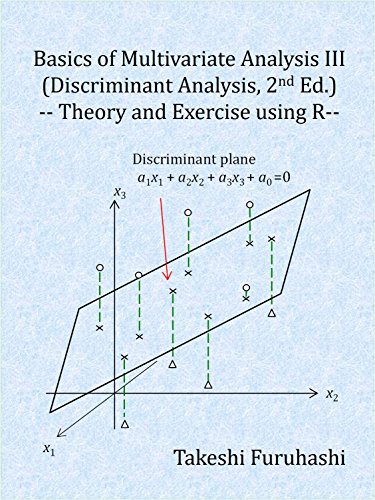
Basics of Multivariate Analysis III (Discriminant Analysis, 2nd Edition): Theory and Exercise using R
by Takeshi Furuhashi
No club is reading this yet — be the first to start one
Readers of this book should be familiar with the basics of differentiation, vectors (including their inner product) and matrix analysis (including their product, transpose, inverse, and eigenvalues).
The scripts used in this book can be downloaded from the website:
http://www.mybook-pub-site.sakura.ne.jp/multi_variate_analysis/DA/index.html
This book uses R 3.3.0 for Windows. The software is freely downloadable from http://cran.r-project.org/. This book uses the Windows versions of scripts. Mac users need only to change the file path to load the data files.
Table of Contents
1 Introduction
2 Bivariate Linear Discriminant Analysis
2.1 Basic Theory
2.2 Numerical Example 1
2.3 Matrix Expression
2.4 Matrix Calculation using R
2.5 Calculation using lda()
3 Determination of the constant c
3.1 Mahalanobis distance
3.2 Determination of constant c
3.3 Calculation using R
3.4 Classification of unknown data
4 Multi-Variate Linear Discriminant Analysis
4.1 Matrix Expression
4.2 Determination of constant a0
4.3 Calculation using R
4.4 Calculation using the lda() function
4.5 Classification of unknown data
5 Nonlinear Discriminant Analysis
5.1 Bivariate Normal Distribution
5.2 Mahalanobis distance
5.3 Calculation using R
5.4 Matrix expression of bivariate normal distribution
5.5 Calculation using R
5.6 Matrix expression of n-variate normal distribution
5.7 Classification of iris data using R
5.8 Calculation of iris data using R’s mahalanobis() function
5.9 Comparison of classified results of linear/nonlinear discriminant analyses
5.10 Comparison of classified results using predict() function
5.11 Theory of predict() function (Bayes rule)
6 Concluding Remarks
Discuss Basics of Multivariate Analysis III (Discriminant Analysis, 2nd Edition): Theory and Exercise using R with other readers
Join or start a book club for Basics of Multivariate Analysis III (Discriminant Analysis, 2nd Edition): Theory and Exercise using R on Readfeed. Live chat, shared reading progress, and AI discussion questions — free to get started.
Frequently asked questions
How do I join a book club for Basics of Multivariate Analysis III (Discriminant Analysis, 2nd Edition): Theory and Exercise using R?
Sign up free on Readfeed, then browse public clubs or start your own club with Basics of Multivariate Analysis III (Discriminant Analysis, 2nd Edition): Theory and Exercise using R as the current read. Invite friends with a share link and discuss together with live chat and AI discussion questions.
Can I discuss Basics of Multivariate Analysis III (Discriminant Analysis, 2nd Edition): Theory and Exercise using R with other readers online?
Yes. Readfeed book clubs let you chat live, share progress, and join discussions about Basics of Multivariate Analysis III (Discriminant Analysis, 2nd Edition): Theory and Exercise using R with readers worldwide — whether your club is virtual, in-person, or hybrid.
Is Readfeed free?
Yes. Creating an account and joining book clubs is free. Sign up to find readers who love the same books and start discussing today.