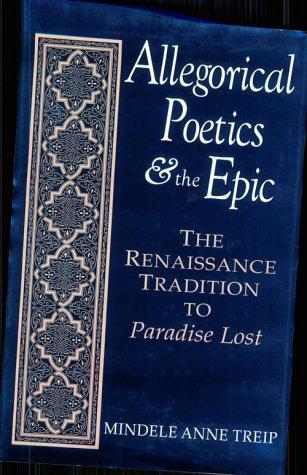
Literary allegory has deep roots in early reading and interpretation of Scripture and classical epic and myth. In this substantial study Mindele Treip presents an overview of the history and theory of allegory in and allegorical exegesis upon Scripture, poetry and especially the epic from antiquity to the seventeenth and early eighteenth centuries, with close focus on the Renaissance and on the triangular literary relationship of Tasso, Spenser and Milton.
Exploring the different ways in which the term allegory has been understood, Treip finds significant continuities-within-differences in a wide range of critical writings, including texts of postclassical, patristic and rabbinical writers, medieval writers, notably Dante, Renaissance theorists such as Coluccio Salutati, Bacon, Sidney, John Harington and rhetoricians and mythographers, and the neoclassical critics of Italy, England and France, including Le Bossu.
In particular, she traces the evolving theories on allegory and the epic of Torquato Tasso through a wide spectrum of his major discourses, shorter trace and letters, giving full translations.
Treip argues that Milton wrote, as in part did Spenser, within the definitive framework of the mixed historical-allegorical epic erected by Tasso, and she shows Spenser's and Milton's epics as significantly shaped by Tasso's formulations, as well as by his allegorical structures and images in the Gerusalemme liberata.
In the last part of her study Treip addresses the complex problematics of reading Paradise Lost as both a consciously Reformation poem and one written within the older epic allegorical tradition, and she also illustrates Milton's innovative uses of biblical "Accommodation" theory so as to create a variety of radical allegorical metaphors in his poem.
This study brings together a wide range of critical issues - the Homeric-Virgilian tradition of allegorical reading of epic; early Renaissance theory of all poetry as "translation" or allegorical metaphor; midrashic linguistic techniques in the representation of the Word; Milton's God; neoclassical strictures on Milton's allegory and allegory in general - all of these are brought together in new and comprehensive perspective.
Allegorical Poe tics and the Epic, with its redefining of allegorical mode and language and its revisionary readings of Tasso's theories and Milton's artistry, will interest not only Miltonists, Spenserians and students of comparative literature but all concerned with the history of epic, rhetoric and the newly developing fields of language theory and theory of allegory.