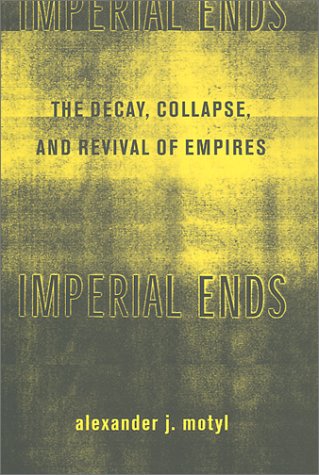
Imperial Ends
by Alexander J. Motyl, Alexander Motyl
128 pages· 2001· ISBN 9780231121101
About
Despite their historical importance, empires have received scant attention from social scientists. Now, Alexander J. Motyl examines the structure, dynamics, and continuing relevance of empire―and asks, "Why do empires decline? Why do some empires collapse? And why do some collapsed empires revive?"
Rejecting choice-centered theories of imperial decline, Motyl maintains that the very structure of empires promotes decay and that decay in turn facilitates the progressive loss of territory. Although most major empires have in fact declined in this manner, some, such as the Soviet Union, have collapsed suddenly and comprehensively. Motyl explains how and why collapse occurs, why such an outcome is hard to foresee, and why some collapsed empires revive. While broad-ranging historically and empirically, Imperial Ends focuses on five modern empires: the Soviet, Romanov, Ottoman, Habsburg, and Wilhelmine.
Examining the possibility of a revival of the Soviet empire, Motyl points out that the expansion of NATO and the European Union, along with increasing globalization, will isolate Russia and its neighbors, promoting their dependence upon one another and perhaps facilitating the rise of the former core.
With boldly stated conclusions and concise analytical interpretations, Imperial Ends cohesively illustrates to policymakers and social scientists alike the importance of possible imperial revivals and the rise of future empires.
Rejecting choice-centered theories of imperial decline, Motyl maintains that the very structure of empires promotes decay and that decay in turn facilitates the progressive loss of territory. Although most major empires have in fact declined in this manner, some, such as the Soviet Union, have collapsed suddenly and comprehensively. Motyl explains how and why collapse occurs, why such an outcome is hard to foresee, and why some collapsed empires revive. While broad-ranging historically and empirically, Imperial Ends focuses on five modern empires: the Soviet, Romanov, Ottoman, Habsburg, and Wilhelmine.
Examining the possibility of a revival of the Soviet empire, Motyl points out that the expansion of NATO and the European Union, along with increasing globalization, will isolate Russia and its neighbors, promoting their dependence upon one another and perhaps facilitating the rise of the former core.
With boldly stated conclusions and concise analytical interpretations, Imperial Ends cohesively illustrates to policymakers and social scientists alike the importance of possible imperial revivals and the rise of future empires.
Discuss Imperial Ends with other readers
Join or start a book club for Imperial Ends on Readfeed. Live chat, shared reading progress, and AI discussion questions — free to get started.
Frequently asked questions
How do I join a book club for Imperial Ends?
Sign up free on Readfeed, then browse public clubs or start your own club with Imperial Ends as the current read. Invite friends with a share link and discuss together with live chat and AI discussion questions.
Can I discuss Imperial Ends with other readers online?
Yes. Readfeed book clubs let you chat live, share progress, and join discussions about Imperial Ends with readers worldwide — whether your club is virtual, in-person, or hybrid.
Is Readfeed free?
Yes. Creating an account and joining book clubs is free. Sign up to find readers who love the same books and start discussing today.