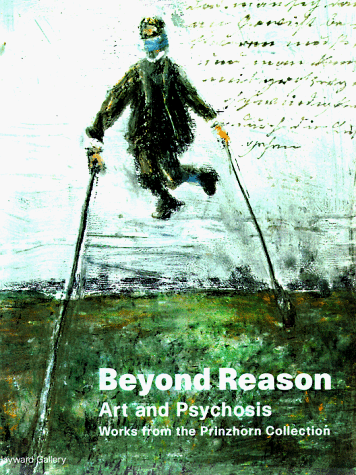
In the early 1920s the German art historian and psychiatrist, Hans Prinzhorn (1886-1933), amassed a remarkable collection of some 5,000 paintings, drawings, objects, and collages made by patients in European psychiatric institutions. His interest, unique at the time, was twofold: to assess the art as creative work, and to use it as a way of studying mental illness. Prinzhorn's Collection attracted the attention of many artists, including Paul Klee and Oskar Schlemmer, but by the 1930s, when the Nazis declared such work "degenerate," the Collection fell into disrepair. Only in recent decades has it been properly restored and made available for a wider public. This catalog accompanied the first exhibition in Britain to foreground the Prinzhorn Collection as a whole. The works represented in these pages defy simple categorization: The range is extraordinary and the art's startling sophistication, inventiveness, and beauty inevitably prompt comparison with such artists as Max Ernst and the Surrealists and with Jean Dubuffet. Three texts are immensely helpful in providing an understanding of the Collection's importance: Bettina Brand-Claussen deals with the Collection's origins within the changing culture of postwar Europe; Inge Jdi offers a meditation on the ethical, interpretative, and aesthetic questions in presenting the Collection; and Caroline Douglas sets Prinzhorn's endeavor within a broader historical and intellectual context. Questions surrounding art and madness are endlessly fascinating, no more so than today, as science moves to unlock the mysteries of the mind. The Prinzhorn Collection will do much to inspire continuing debate on the links between creativity, rationality, and illness. In the early 1920s the German art historian and psychiatrist, Hans Prinzhorn (1886-1933), amassed a remarkable collection of some 5,000 paintings, drawings, objects, and collages made by patients in European psychiatric institutions. His interest, unique at the time, was twofold: to assess the art as creative work, and to use it as a way of studying mental illness. Prinzhorn's Collection attracted the attention of many artists, including Paul Klee and Oskar Schlemmer, but by the 1930s, when the Nazis declared such work "degenerate," the Collection fell into disrepair. Only in recent decades has it been properly restored and made available for a wider public. This catalog accompanied the first exhibition in Britain to foreground the Prinzhorn Collection as a whole. The works represented in these pages defy simple categorization: The range is extraordinary and the art's startling sophistication, inventiveness, and beauty inevitably prompt comparison with such artists as Max Ernst and the Surrealists and with Jean Dubuffet. Three texts are immensely helpful in providing an understanding of the Collection's importance: Bettina Brand-Claussen deals with the Collection's origins within the changing culture of postwar Europe; Inge Jdi offers a meditation on the ethical, interpretative, and aesthetic questions in presenting the Collection; and Caroline Douglas sets Prinzhorn's endeavor within a broader historical and intellectual context. Questions surrounding art and madness are endlessly fascinating, no more so than today, as science moves to unlock the mysteries of the mind. The Prinzhorn Collection will do much to inspire continuing debate on the links between creativity, rationality, and illness.