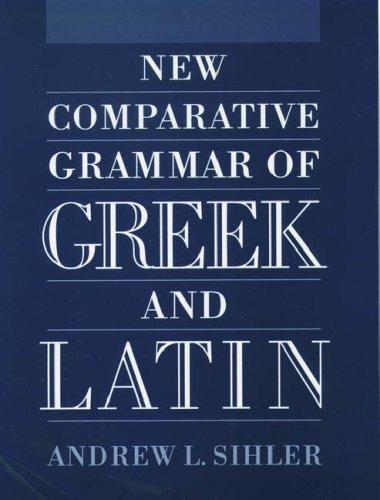
New comparative grammar of Greek and Latin

New comparative grammar of Greek and Latin

by Andrew L. Sihler

Browse books you can read free on Readfeed

No club is reading this yet — be the first to start one

1 readers worldwide want to read this book

Start a club free
About
"Like Carl Darling Buck's Comparative Grammar of Greek and Latin (1933), this book is an explanation of the similarities and differences between Greek and Latin morphology and lexicon through an account of their prehistory. It also aims to discuss the principal features of Indo-European linguistics. Greek and Latin are studied as a pair for cultural reasons only; as languages, they have little in common apart from their Indo-European heritage. Thus the only way to treat the historical bases for their development is to begin with Proto-Indo-European. The only way to make a reconstructed language like Proto-Indo-European intelligible and intellectually defensible is to present at least some of the basis for reconstructing its features and, in the process, to discuss reasoning and methodology of reconstruction (including a weighing of alternative reconstructions). The result is a compendious handbook of Indo-European phonology and morphology, and a vade mecum of Indo-European linguistics--the focus always remaining on Greek and Latin. The non-classical sources for historical discussion are mainly Vedic Sanskrit, Hittite, and Germanic, with occasional but crucial contributions from Old Irish, Avestan, Baltic, and Slavic"--P. [4] of cover.

Discuss New comparative grammar of Greek and Latin with other readers

Join or start a book club for New comparative grammar of Greek and Latin on Readfeed. Live chat, shared reading progress, and AI discussion questions — free to get started.

Frequently asked questions

How do I join a book club for New comparative grammar of Greek and Latin?

Sign up free on Readfeed, then browse public clubs or start your own club with New comparative grammar of Greek and Latin as the current read. Invite friends with a share link and discuss together with live chat and AI discussion questions.

Can I discuss New comparative grammar of Greek and Latin with other readers online?

Yes. Readfeed book clubs let you chat live, share progress, and join discussions about New comparative grammar of Greek and Latin with readers worldwide — whether your club is virtual, in-person, or hybrid.

Is Readfeed free?

Yes. Creating an account and joining book clubs is free. Sign up to find readers who love the same books and start discussing today.