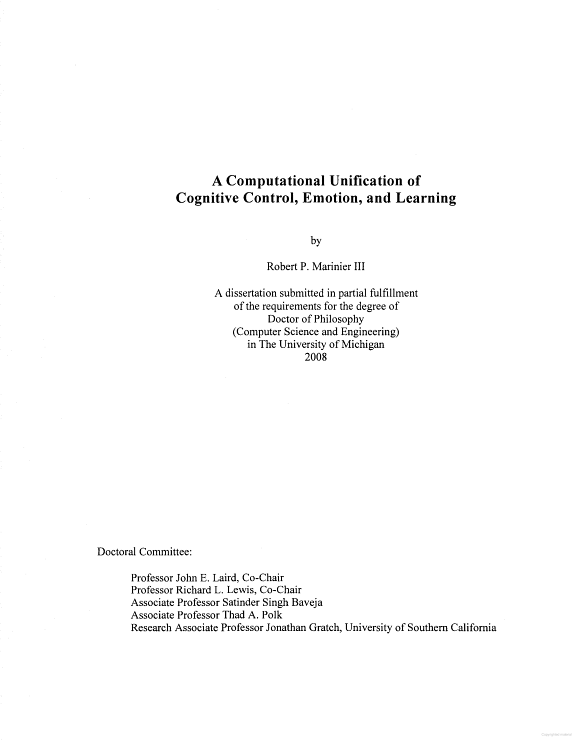
A Computational Unification of Cognitive Control, Emotion, and Learning

A Computational Unification of Cognitive Control, Emotion, and Learning

147 pages· 2008· ISBN 9780549818649
About
Existing models that integrate emotion and cognition generally do not fully specify why cognition needs emotion and conversely why emotion needs cognition. In this thesis, we present a unified computational model that combines an abstract cognitive theory of behavior control (PEACTIDM) and a detailed theory of emotion (based on an appraisal theory), integrated in a theory of cognitive architecture (Soar). The theory of cognitive control specifies a set of required computational functions and their abstract inputs and outputs, while the appraisal theory specifies in more detail the nature of these inputs and outputs and an ontology for their representation. We argue that there is a surprising functional symbiosis between these two independently motivated theories that leads to a deeper theoretical integration than has been previously obtained in other computational treatments of cognition and emotion. We use an implemented model in Soar to test the feasibility of the resulting integrated theory, and explore its implications and predictive power in several task domains. With this integration, we then explore a possible functional benefit of emotion; namely, as an intrinsic motivator of reinforcement learning. This integration leads to other reinforcement learning extensions, such as automatic setting of the learning and exploration rate parameters.

Discuss A Computational Unification of Cognitive Control, Emotion, and Learning with other readers

Join or start a book club for A Computational Unification of Cognitive Control, Emotion, and Learning on Readfeed. Live chat, shared reading progress, and AI discussion questions — free to get started.

Frequently asked questions

How do I join a book club for A Computational Unification of Cognitive Control, Emotion, and Learning?

Sign up free on Readfeed, then browse public clubs or start your own club with A Computational Unification of Cognitive Control, Emotion, and Learning as the current read. Invite friends with a share link and discuss together with live chat and AI discussion questions.

Can I discuss A Computational Unification of Cognitive Control, Emotion, and Learning with other readers online?

Yes. Readfeed book clubs let you chat live, share progress, and join discussions about A Computational Unification of Cognitive Control, Emotion, and Learning with readers worldwide — whether your club is virtual, in-person, or hybrid.

Is Readfeed free?

Yes. Creating an account and joining book clubs is free. Sign up to find readers who love the same books and start discussing today.