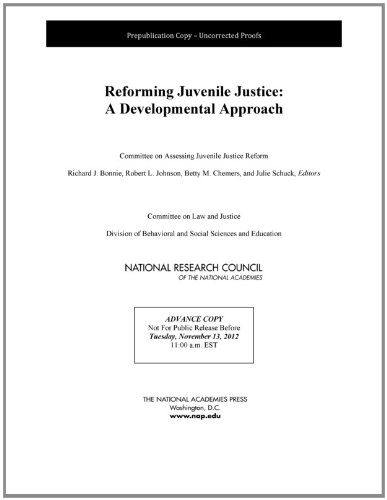
Reforming Juvenile Justice: A Developmental Approach
A Developmental Approach
by Division of Behavioral and Social Sciences and Education, National Research Council, Committee on Assessing Juvenile Justice Reform, Committee on Law and Justice
Adolescence is a distinct, yet transient, period of development between childhood and adulthood characterized by increased experimentation and risk-taking, a tendency to discount long-term consequences, and heightened sensitivity to peers and other social influences. A key function of adolescence is developing an integrated sense of self, including individualization, separation from parents, and personal identity. Experimentation and novelty-seeking behavior, such as alcohol and drug use, unsafe sex, and reckless driving, are thought to serve a number of adaptive functions despite their risks.
Research indicates that for most youth, the period of risky experimentation does not extend beyond adolescence, ceasing as identity becomes settled with maturity. Much adolescent involvement in criminal activity is part of the normal developmental process of identity formation and most adolescents will mature out of these tendencies. Evidence of significant changes in brain structure and function during adolescence strongly suggests that these cognitive tendencies characteristic of adolescents are associated with biological immaturity of the brain and with an imbalance among developing brain systems. This imbalance model implies dual systems: one involved in cognitive and behavioral control and one involved in socio-emotional processes. Accordingly adolescents lack mature capacity for self-regulations because the brain system that influences pleasure-seeking and emotional reactivity develops more rapidly than the brain system that supports self-control. This knowledge of adolescent development has underscored important differences between adults and adolescents with direct bearing on the design and operation of the justice system, raising doubts about the core assumptions driving the criminalization of juvenile justice policy in the late decades of the 20th century.
It was in this context that the Office of Juvenile Justice and Delinquency Prevention (OJJDP) asked the National Research Council to convene a committee to conduct a study of juvenile justice reform. The goal of Reforming Juvenile Justice: A Developmental Approach was to review recent advances in behavioral and neuroscience research and draw out the implications of this knowledge for juvenile justice reform, to assess the new generation of reform activities occurring in the United States, and to assess the performance of OJJDP in carrying out its statutory mission as well as its potential role in supporting scientifically based reform efforts.
Discuss Reforming Juvenile Justice: A Developmental Approach with other readers
Join or start a book club for Reforming Juvenile Justice: A Developmental Approach on Readfeed. Live chat, shared reading progress, and AI discussion questions — free to get started.
Frequently asked questions
How do I join a book club for Reforming Juvenile Justice: A Developmental Approach?
Sign up free on Readfeed, then browse public clubs or start your own club with Reforming Juvenile Justice: A Developmental Approach as the current read. Invite friends with a share link and discuss together with live chat and AI discussion questions.
Can I discuss Reforming Juvenile Justice: A Developmental Approach with other readers online?
Yes. Readfeed book clubs let you chat live, share progress, and join discussions about Reforming Juvenile Justice: A Developmental Approach with readers worldwide — whether your club is virtual, in-person, or hybrid.
Is Readfeed free?
Yes. Creating an account and joining book clubs is free. Sign up to find readers who love the same books and start discussing today.