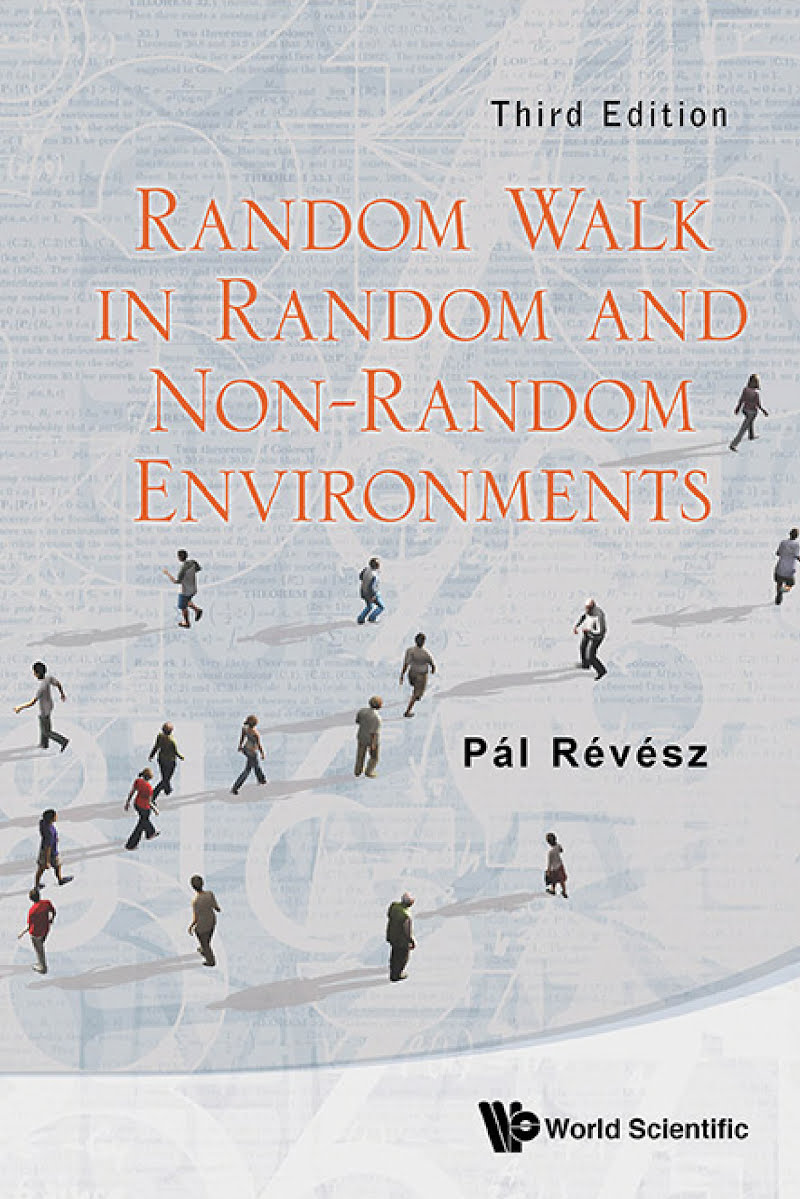
Random Walk in Random and Non-Random Environments

Random Walk in Random and Non-Random Environments

by Pál Révész

420 pages· 2013· ISBN 9789814447522
About
The simplest mathematical model of the Brownian motion of physics is the simple, symmetric random walk. This book collects and compares current results — mostly strong theorems which describe the properties of a random walk. The modern problems of the limit theorems of probability theory are treated in the simple case of coin tossing. Taking advantage of this simplicity, the reader is familiarized with limit theorems (especially strong ones) without the burden of technical tools and difficulties. An easy way of considering the Wiener process is also given, through the study of the random walk. Since the first and second editions were published in 1990 and 2005, a number of new results have appeared in the literature. The first two editions contained many unsolved problems and conjectures which have since been settled; this third, revised and enlarged edition includes those new results. In this edition, a completely new part is included concerning Simple Random Walks on Graphs. Properties of random walks on several concrete graphs have been studied in the last decade. Some of the obtained results are also presented. Contents:Simple Symmetric Random Walk in ℤ1:Introduction of Part IDistributionsRecurrence and the Zero-One LawFrom the Strong Law of Large Numbers to the Law of Iterated LogarithmLévy ClassesWiener Process and Invariance PrincipleIncrementsStrassen Type TheoremsDistribution of the Local TimeLocal Time and Invariance PrincipleStrong Theorems of the Local TimeExcursionsFrequently and Rarely Visited SitesAn Embedding TheoremA Few Further ResultsSummary of Part ISimple Symmetric Random Walk in ℤd:The Recurrence TheoremWiener Process and Invariance PrincipleThe Law of Iterated LogarithmLocal TimeThe RangeHeavy Points and Heavy BallsCrossing and Self-crossingLarge Covered BallsLong ExcursionsSpeed of EscapeA Few Further ProblemsRandom Walk in Random Environment:Introduction of Part IIIIn the First Six DaysAfter the Sixth DayWhat Can a Physicist Say About the Local Time ξ(0,n)?On the Favourite Value of the RWIREA Few Further ProblemsRandom Walks in Graphs:Introduction of Part IVRandom Walk in CombRandom Walk in a Comb and in a Brush with CrossingsRandom Walk on a SpiderRandom Walk in Half-Plane-Half-Comb Readership: Graduate students and researchers in probability theory and statistical physics. Keywords:Random Walk;Non-Random Environments;Lévy Classes;Strassen Type Theorems;Invariance PrincipleKey Features:Provides an elementary presentation of the properties of Brownian motionContains the newest results of the subjectReviews: Reviews of the Previous Editions: “This book tells a very personal and exciting story from the point of view of one of the dominant contributors to the study of random walks, and will be of interest to those looking for intriguing open problems in the theory of random walks and associated strong limit laws.” Mathematical Reviews “The reader interested in the theory of random walks in non-random environments and also on the associated strong limit laws will find this book very interesting and also very useful.” Zentralblatt MATH “The expert will get as much out of the book as will the novice. It makes ideal reading material for a graduate course on the subject. As the ‘Hungarian’ follow-up to Spitzer's classic, I am convinced that many will be grateful for the creation of this excellent monograph.” Paul Embrechts Eidgenössische Technische Hochschule Zürich, Switzerland “The book will be useful to the many devotees of random walk and should attract more people to the area.”H Kesten (1-CRNL) Mathematical Reviews Review of the First Edition: “This useful and fascinating monograph gives a detailed description of the latest results on a broad spectrum of problems concerning the simple random walk {Sn} on the lattice Zd and their relation (invariance principle) to analogous problems for Brownian motion. Perhaps half of these results are proved in full detail. Many results appear here for the first time in book form. The book is very readable.” J H B Kemperman SIAM Review, USA “A number of recent results and interesting open problems are presented, which have not appeared in any other book so far. The style of writing is clear and pleasant. The book is recommended for both introductory and advanced courses and also for researchers in probability theory and statistical physics.” Endre Csáki Statistics & Decisions

Discuss Random Walk in Random and Non-Random Environments with other readers

Join or start a book club for Random Walk in Random and Non-Random Environments on Readfeed. Live chat, shared reading progress, and AI discussion questions — free to get started.

Frequently asked questions

How do I join a book club for Random Walk in Random and Non-Random Environments?

Sign up free on Readfeed, then browse public clubs or start your own club with Random Walk in Random and Non-Random Environments as the current read. Invite friends with a share link and discuss together with live chat and AI discussion questions.

Can I discuss Random Walk in Random and Non-Random Environments with other readers online?

Yes. Readfeed book clubs let you chat live, share progress, and join discussions about Random Walk in Random and Non-Random Environments with readers worldwide — whether your club is virtual, in-person, or hybrid.

Is Readfeed free?

Yes. Creating an account and joining book clubs is free. Sign up to find readers who love the same books and start discussing today.