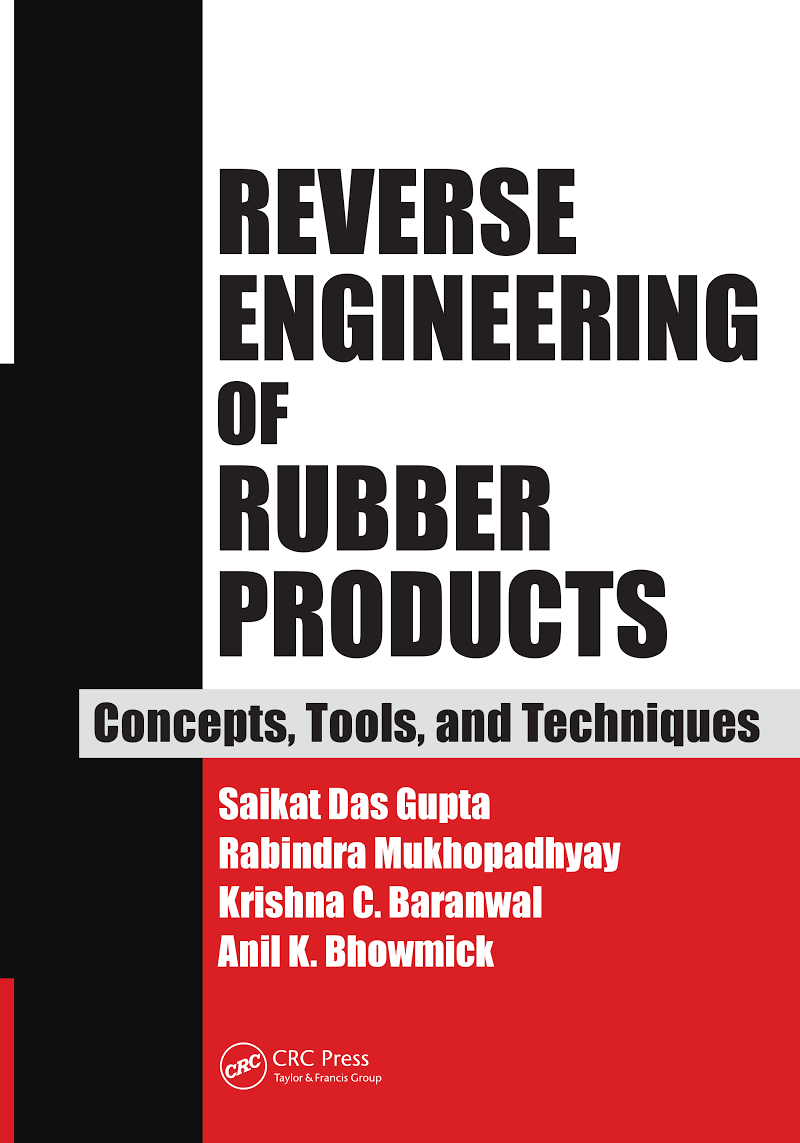
Reverse Engineering of Rubber Products

Reverse Engineering of Rubber Products

Concepts, Tools, and Techniques

by Saikat Das Gupta, Rabindra Mukhopadhyay, Krishna C. Baranwal, Anil K. Bhowmick

357 pages· 2013· ISBN 9780849373169

Browse books you can read free on Readfeed

No club is reading this yet — be the first to start one

Start a club free
About
Reverse engineering is widely practiced in the rubber industry. Companies routinely analyze competitors’ products to gather information about specifications or compositions. In a competitive market, introducing new products with better features and at a faster pace is critical for any manufacturer. Reverse Engineering of Rubber Products: Concepts, Tools, and Techniques explains the principles and science behind rubber formulation development by reverse engineering methods. The book describes the tools and analytical techniques used to discover which materials and processes were used to produce a particular vulcanized rubber compound from a combination of raw rubber, chemicals, and pigments. A Compendium of Chemical, Analytical, and Physical Test Methods Organized into five chapters, the book first reviews the construction of compounding ingredients and formulations, from elastomers, fillers, and protective agents to vulcanizing chemicals and processing aids. It then discusses chemical and analytical methods, including infrared spectroscopy, thermal analysis, chromatography, and microscopy. It also examines physical test methods for visco-elastic behavior, heat aging, hardness, and other features. A chapter presents important reverse engineering concepts. In addition, the book includes a wide variety of case studies of formula reconstruction, covering large products such as tires and belts as well as smaller products like seals and hoses. Get Practical Insights on Reverse Engineering from the Book’s Case Studies Combining scientific principles and practical advice, this book brings together helpful insights on reverse engineering in the rubber industry. It is an invaluable reference for scientists, engineers, and researchers who want to produce comparative benchmark information, discover formulations used throughout the industry, improve product performance, and shorten the product development cycle.

Discuss Reverse Engineering of Rubber Products with other readers

Join or start a book club for Reverse Engineering of Rubber Products on Readfeed. Live chat, shared reading progress, and AI discussion questions — free to get started.

Frequently asked questions

How do I join a book club for Reverse Engineering of Rubber Products?

Sign up free on Readfeed, then browse public clubs or start your own club with Reverse Engineering of Rubber Products as the current read. Invite friends with a share link and discuss together with live chat and AI discussion questions.

Can I discuss Reverse Engineering of Rubber Products with other readers online?

Yes. Readfeed book clubs let you chat live, share progress, and join discussions about Reverse Engineering of Rubber Products with readers worldwide — whether your club is virtual, in-person, or hybrid.

Is Readfeed free?

Yes. Creating an account and joining book clubs is free. Sign up to find readers who love the same books and start discussing today.