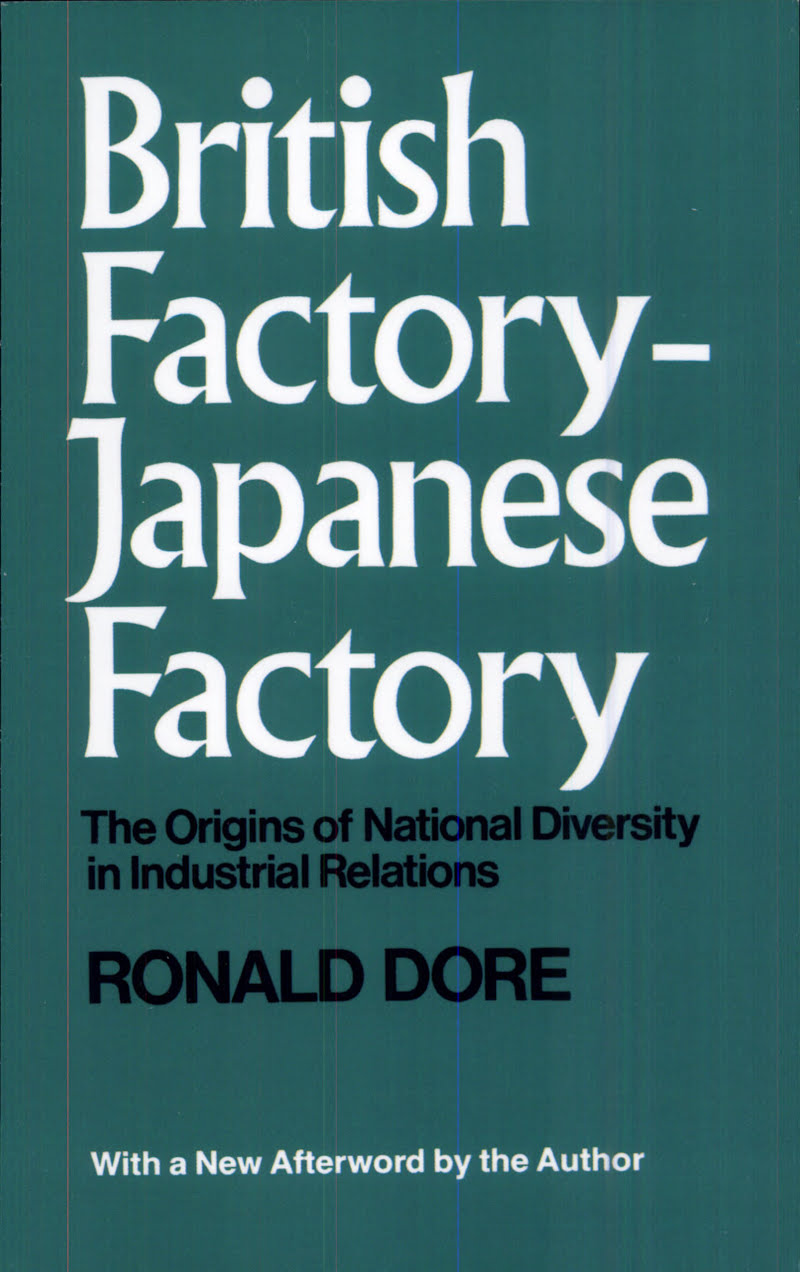
British Factory, Japanese Factory

British Factory, Japanese Factory

The Origins of National Diversity in Industrial Relations

by Ronald Philip Dore

467 pages· 1990· ISBN 9780520024953

Browse books you can read free on Readfeed

No club is reading this yet — be the first to start one

Start a club free
About
The Japanese way of work is notoriously 'different.' But is it Japan or Britain which is the odd man out? This is the first book to explore the real differences, not by contrasting Japanese employment relations with a hazy ideal image of 'the West,” but through a point-by-point comparison of two Japanese factories with two British ones making similar products. In the first half of the book this comparison is pursued in systematic detail and with vivid illustrations of the attitudes and assumptions which underlie what the author calls the 'market-oriented” system of Britain and the 'organization-oriented' system of Japan. But these descriptions are only the beginning of a broader analysis. One chapter shows how the employment institutions of the two countries fit into their political, family and educational institutions-an exercise in functionalist sociology without the functionalist's usual claim to be so different-dominates the later chapters and these make a major contribution to the discussion of development and of the 'convergence' of different systems. Are the Japanese being weaned from their 'pre-modern' practices and becoming more like us? On the contrary, Professor Dore finds more signs of our moving in a Japanese direction. The convergence theorists are wrong in taking the market-oriented employment systems created by the peculiarities of nineteenth-century capitalism as necessarily a permanent part of 'modern' industrial relations. This brings the author to the 'late-development' effect. From a wealth of historical evidence, he argues that Japan's organization-oriented system is not simply a manifestation of Japan's unique culture, nor a hang-over from pre-industrial relations. Late-developers can 'get ahead,' adopting patterns of organization which in older industrial countries are still struggling to break through the crust of nineteenth-century institutions. He supports his thesis with evidence from Asia, Africa, and Latin America. If accepted, its importance for policy in these regions is obvious.

Discuss British Factory, Japanese Factory with other readers

Join or start a book club for British Factory, Japanese Factory on Readfeed. Live chat, shared reading progress, and AI discussion questions — free to get started.

Frequently asked questions

How do I join a book club for British Factory, Japanese Factory?

Sign up free on Readfeed, then browse public clubs or start your own club with British Factory, Japanese Factory as the current read. Invite friends with a share link and discuss together with live chat and AI discussion questions.

Can I discuss British Factory, Japanese Factory with other readers online?

Yes. Readfeed book clubs let you chat live, share progress, and join discussions about British Factory, Japanese Factory with readers worldwide — whether your club is virtual, in-person, or hybrid.

Is Readfeed free?

Yes. Creating an account and joining book clubs is free. Sign up to find readers who love the same books and start discussing today.