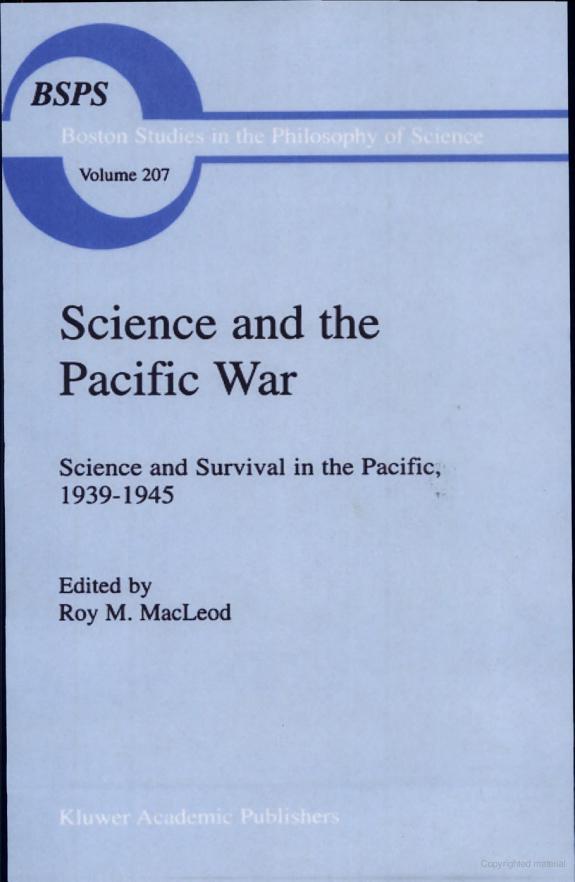
Science and the Pacific War

Science and the Pacific War

Science and Survival in the Pacific, 1939–1945

by Roy M. MacLeod

352 pages· 1999· ISBN 9780792358510
About
In 1995, the fiftieth anniversary of the end of the Second World War occasioned many reflections on the place of science and technology in the conflict. That the war ended with Allied victory in the Pacific theatre, inevitably focussed attention upon the Pacific region, and particularly upon the Manhattan project and its outcome. It was in the Pacific that Western physics and engineering gave birth to the Atomic Age. However, the Pacific war had also proved a testing time, and a testing space, for other disciplines and institutions. Extreme environments and opemtional distances, and the fundamental demands of logistics, required the Allies and the Japanese to innovate many scientific and technological practices. Just as medicine and botany were called upon to fight tropical diseases and insect pests, so engineers, anthropol ogists and geographers were called upon to understand local conditions and cli mates, and to work with local peoples whose traditional lives were changed forever by the experience. At the same time, the war played midwife to a host of new de velopments, not least in scientific intelligence and in chemical and biological weapons, which were to acquire far greater importance after 1945.

Discuss Science and the Pacific War with other readers

Join or start a book club for Science and the Pacific War on Readfeed. Live chat, shared reading progress, and AI discussion questions — free to get started.

Frequently asked questions

How do I join a book club for Science and the Pacific War?

Sign up free on Readfeed, then browse public clubs or start your own club with Science and the Pacific War as the current read. Invite friends with a share link and discuss together with live chat and AI discussion questions.

Can I discuss Science and the Pacific War with other readers online?

Yes. Readfeed book clubs let you chat live, share progress, and join discussions about Science and the Pacific War with readers worldwide — whether your club is virtual, in-person, or hybrid.

Is Readfeed free?

Yes. Creating an account and joining book clubs is free. Sign up to find readers who love the same books and start discussing today.