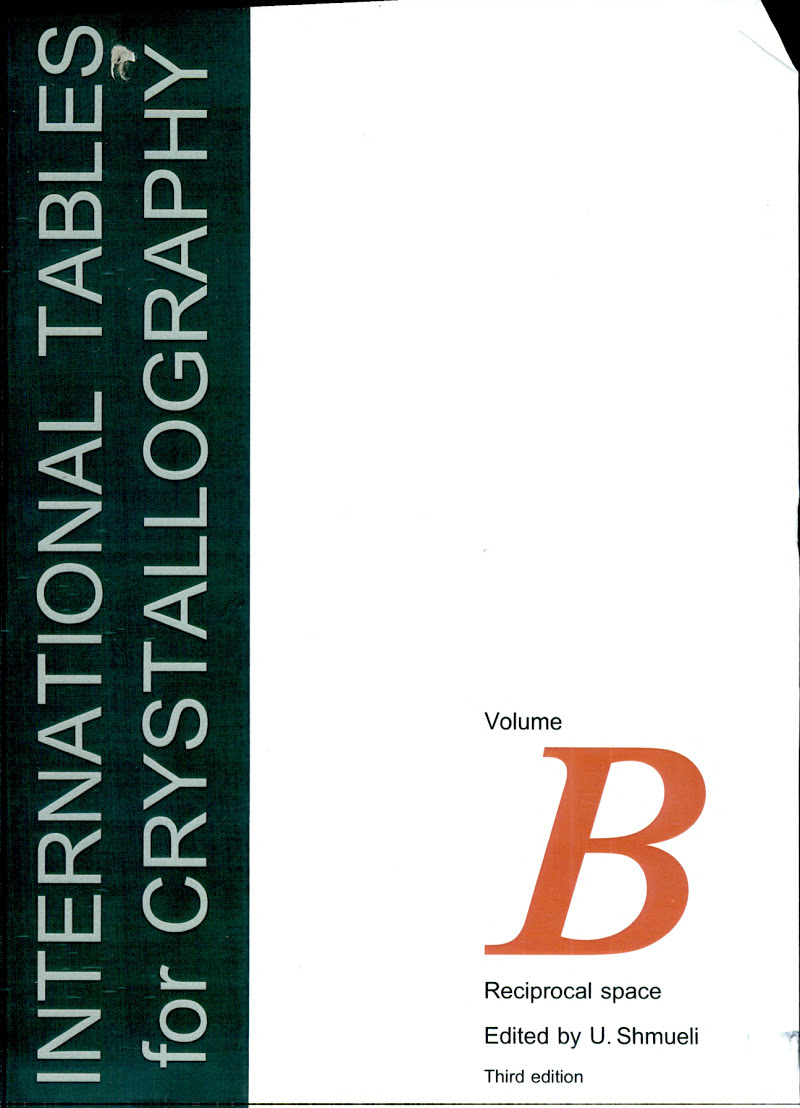
International Tables for Crystallography, Reciprocal Space

International Tables for Crystallography, Reciprocal Space

by Uri Shmueli

696 pages· 2008· ISBN 9781402082054

Browse books you can read free on Readfeed

No club is reading this yet — be the first to start one

Start a club free
About
International Tables for Crystallography are no longer available for purchase from Springer. For further information please contact Wiley Inc. (follow the link on the right hand side of this page). Volume B presents accounts of the numerous aspects of reciprocal space in crystallographic research. After an introductory chapter, Part 1 presents the reader with an account of structure-factor formalisms, an extensive treatment of the theory, algorithms and crystallographic applications of Fourier methods, and fundamental as well as advanced treatments of symmetry in reciprocal space. In Part 2, these general accounts are followed by detailed expositions of crystallographic statistics, the theory of direct methods, Patterson techniques, isomorphous replacement and anomalous scattering, and treatments of the role of electron microscopy and diffraction in crystal structure determination, including applications of direct methods to electron crystallography. Part 3 deals with applications of reciprocal space to molecular geometry and `best'-plane calculations, and contains a treatment of the principles of molecular graphics and modelling and their applications. A convergence-acceleration method of importance in the computation of approximate lattice sums is presented and the part concludes with a discussion of the Ewald method. Part 4 contains treatments of various diffuse-scattering phenomena arising from crystal dynamics, disorder and low dimensionality (liquid crystals), and an exposition of the underlying theories and/or experimental evidence. Polymer crystallography and reciprocal-space images of aperiodic crystals are also treated. Part 5 of the volume contains introductory treatments of the theory of the interaction of radiation with matter (dynamical theory) as applied to X-ray, electron and neutron diffraction techniques. The simplified trigonometric expressions for the structure factors in the 230 three-dimensional space groups, which appeared in Volume I of International Tables for X-ray Crystallography, are now given in Appendix 1.4.3 to Chapter 1.4 of this volume. Volume B is a vital addition to the library of scientists engaged in crystal structure determination, crystallographic computing, crystal physics and other fields of crystallographic research. Graduate students specializing in crystallography will find much material suitable for self-study and a rich source of references to the relevant literature.

Discuss International Tables for Crystallography, Reciprocal Space with other readers

Join or start a book club for International Tables for Crystallography, Reciprocal Space on Readfeed. Live chat, shared reading progress, and AI discussion questions — free to get started.

Frequently asked questions

How do I join a book club for International Tables for Crystallography, Reciprocal Space?

Sign up free on Readfeed, then browse public clubs or start your own club with International Tables for Crystallography, Reciprocal Space as the current read. Invite friends with a share link and discuss together with live chat and AI discussion questions.

Can I discuss International Tables for Crystallography, Reciprocal Space with other readers online?

Yes. Readfeed book clubs let you chat live, share progress, and join discussions about International Tables for Crystallography, Reciprocal Space with readers worldwide — whether your club is virtual, in-person, or hybrid.

Is Readfeed free?

Yes. Creating an account and joining book clubs is free. Sign up to find readers who love the same books and start discussing today.