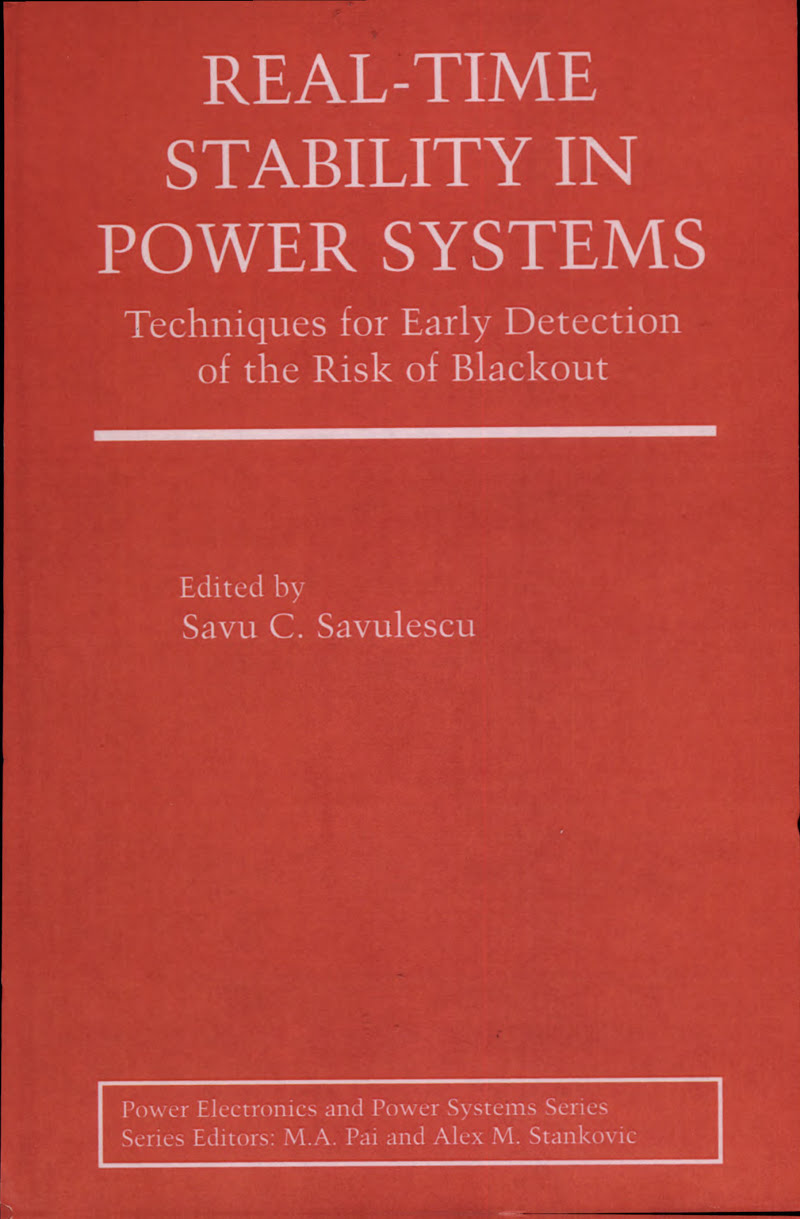
Real-Time Stability in Power Systems

Real-Time Stability in Power Systems

Techniques for Early Detection of the Risk of Blackout

by Savu C. Savulescu

319 pages· 2005· ISBN 9780387256269
About
In the aftermath of the wave of blackouts that affected US, UK and mainland Europe utilities in 2003, deregulation and restructuring were said to have been the main contributing factors, followed by lack of coordination between neighboring ISOs and/or TSOs. The need to reinforce the transmission infrastructure was also invoked - yet no flags were raised by the lack of real-time tools aimed at detecting and alarming system conditions that may develop into blackouts due to instability.In this context, the need to "assess stability" and "predict the risk of blackout" in real-time has become particularly relevant. Early work in this field documented in technical papers published throughout the 1990s and early 2000s underlined the importance of performing stability assessment in real-time. As opposed to classical "steady-state security assessment", however, the very concept of "stability assessment" requires a different metric - and, because of the complexity of the solution techniques involved, innovative approaches are needed to perform such assessment quickly enough so that results could be used for on-line decision-making. On October 13, 2004 the IEEE Power Systems Conference and Expo 2004 hosted the Real-Time Stability Challenge panel session. Organized by the Power System Dynamic Performance Committee, the panel was a forum for presenting progress achieved in this field, discussing new ideas, and identifying challenges to be met in the course of future research.This timely and trend-setting book is built around the panel papers, updated and expanded by the authors with the new material used during the panel presentations. The material is completed with several papers contributed by well-known experts in the field, thus providing an authoritative reference on the theory and implementation of real-time stability assessment -- one of the hottest topics of the day. Issues to be addressed and fully answered include, but are not limited to:*What are the so-much-talked-about "stability limits" and how to objectively define them?*Is there a way to define and measure the "distance to instability"?*How to characterize the risk of blackout?*Can approximate methods be used as a "first line of defense", just like in real-time contingency evaluation where the initial fast approximate calculation is followed by a detailed simulation only if the contingency entails limit violations?*Theoretical description and practical experience with real-time and/or "near real-time" stability applications available today in the SCADA/EMS industry.

Discuss Real-Time Stability in Power Systems with other readers

Join or start a book club for Real-Time Stability in Power Systems on Readfeed. Live chat, shared reading progress, and AI discussion questions — free to get started.

Frequently asked questions

How do I join a book club for Real-Time Stability in Power Systems?

Sign up free on Readfeed, then browse public clubs or start your own club with Real-Time Stability in Power Systems as the current read. Invite friends with a share link and discuss together with live chat and AI discussion questions.

Can I discuss Real-Time Stability in Power Systems with other readers online?

Yes. Readfeed book clubs let you chat live, share progress, and join discussions about Real-Time Stability in Power Systems with readers worldwide — whether your club is virtual, in-person, or hybrid.

Is Readfeed free?

Yes. Creating an account and joining book clubs is free. Sign up to find readers who love the same books and start discussing today.