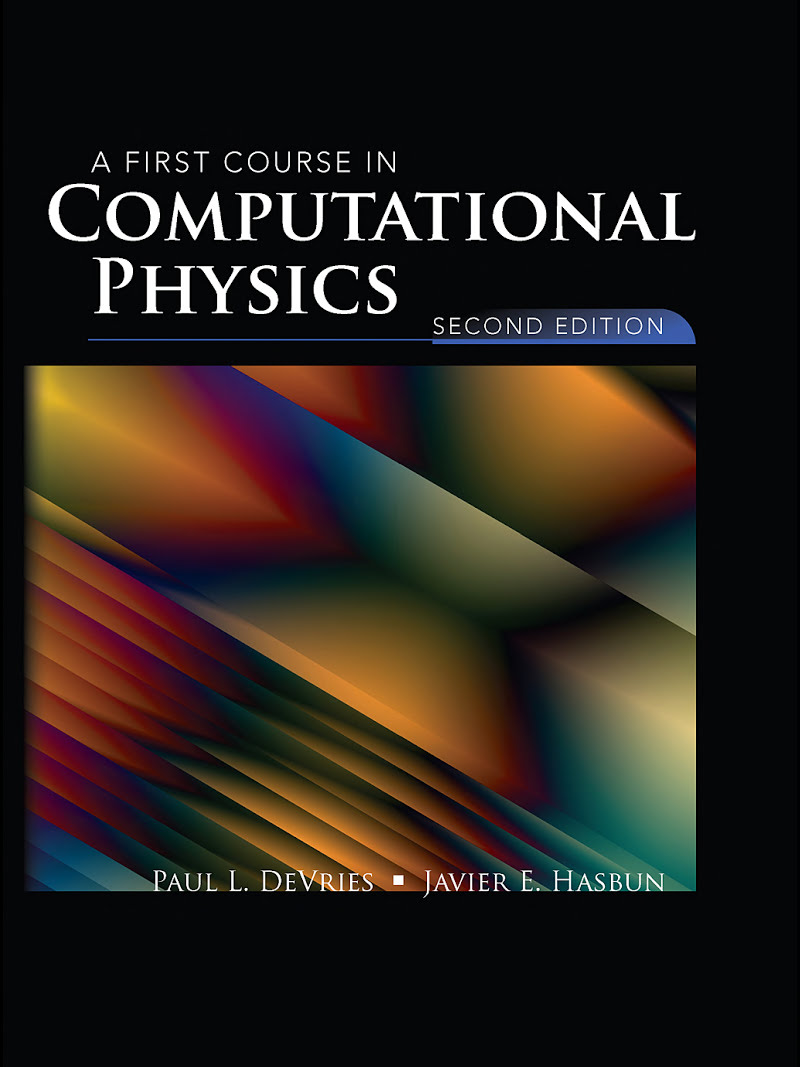
A First Course in Computational Physics

A First Course in Computational Physics

by Paul L. DeVries, Javier E. Hasbun

433 pages· 2011· ISBN 9780763773144

Browse books you can read free on Readfeed

No club is reading this yet — be the first to start one

Start a club free
About
Computers and computation are extremely important components of physics and should be integral parts of a physicist’s education. Furthermore, computational physics is reshaping the way calculations are made in all areas of physics. Intended for the physics and engineering students who have completed the introductory physics course, A First Course in Computational Physics, Second Edition covers the different types of computational problems using MATLAB with exercises developed around problems of physical interest. Topics such as root finding, Newton-Cotes integration, and ordinary differential equations are included and presented in the context of physics problems. A few topics rarely seen at this level such as computerized tomography, are also included. Within each chapter, the student is led from relatively elementary problems and simple numerical approaches through derivations of more complex and sophisticated methods, often culminating in the solution to problems of significant difficulty. The goal is to demonstrate how numerical methods are used to solve the problems that physicists face. Read the review published in Computing in Science & Engineering magazine, March/April 2011 (Vol. 13, No. 2) © 2011 IEEE, Published by the IEEE Computer Society

Discuss A First Course in Computational Physics with other readers

Join or start a book club for A First Course in Computational Physics on Readfeed. Live chat, shared reading progress, and AI discussion questions — free to get started.

Frequently asked questions

How do I join a book club for A First Course in Computational Physics?

Sign up free on Readfeed, then browse public clubs or start your own club with A First Course in Computational Physics as the current read. Invite friends with a share link and discuss together with live chat and AI discussion questions.

Can I discuss A First Course in Computational Physics with other readers online?

Yes. Readfeed book clubs let you chat live, share progress, and join discussions about A First Course in Computational Physics with readers worldwide — whether your club is virtual, in-person, or hybrid.

Is Readfeed free?

Yes. Creating an account and joining book clubs is free. Sign up to find readers who love the same books and start discussing today.