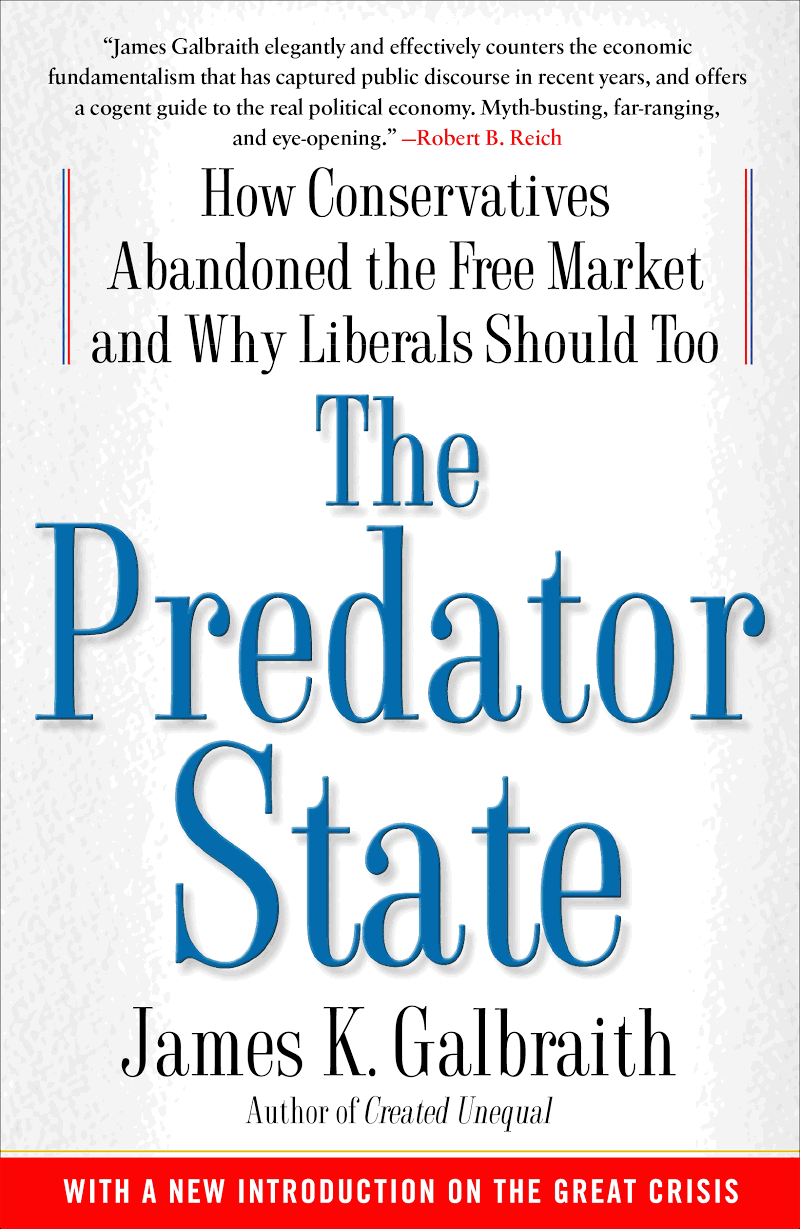
The cult of the free market has dominated economic policy-talk since the Reagan revolution of nearly thirty years ago. Tax cuts and small government, monetarism, balanced budgets, deregulation, and free trade are the core elements of this dogma, a dogma so successful that even many liberals accept it. But a funny thing happened on the bridge to the twenty-first century. While liberals continue to bow before the free-market altar, conservatives in the style of George W. Bush have abandoned it altogether. That is why principled conservatives -- the Reagan true believers -- long ago abandoned Bush. Enter James K. Galbraith, the iconoclastic economist. In this riveting book, Galbraith first dissects the stale remains of Reaganism and shows how Bush and company had no choice except to dump them into the trash. He then explores the true nature of the Bush regime: a "corporate republic," bringing the methods and mentality of big business to public life; a coalition of lobbies, doing the bidding of clients in the oil, mining, military, pharmaceutical, agribusiness, insurance, and media industries; and a predator state, intent not on reducing government but rather on diverting public cash into private hands. In plain English, the Republican Party has been hijacked by political leaders who long since stopped caring if reality conformed to their message. Galbraith follows with an impertinent question: if conservatives no longer take free markets seriously, why should liberals? Why keep liberal thought in the straitjacket of pay-as-you-go, of assigning inflation control to the Federal Reserve, of attempting to "make markets work"? Why not build a new economic policy based on what is really happening in this country? The real economy is not a free-market economy. It is a complex combination of private and public institutions, including Social Security, Medicare and Medicaid, higher education, the housing finance system, and a vast federal research establishment. The real problems and challenges -- inequality, climate change, the infrastructure deficit, the subprime crisis, and the future of the dollar -- are problems that cannot be solved by incantations about the market. They will be solved only with planning, with standards and other policies that transcend and even transform markets. A timely, provocative work whose message will endure beyond this election season, The Predator State will appeal to the broad audience of thoughtful Americans who wish to understand the forces at work in our economy and culture and who seek to live in a nation that is both prosperous and progressive.