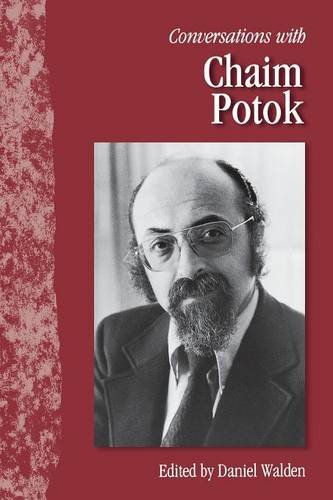
Conversations with Chaim Potok (Literary Conversations Series)
by Daniel Walden
No club is reading this yet — be the first to start one
One of America's most popular Jewish writers, Chaim Potok (b. 1929) is the author of such novels as The Chosen (1967), The Promise (1969), The Book of Lights (1981), and Davita's Harp (1985). Each of his novels explores the tension between tradition and modernity, and the clash between Jewish culture and contemporary Western civilization, which he calls "core-to-core culture confrontation."
Although primarily known as a novelist, Potok is an ordained Conservative rabbi and a world-class Judaic scholar who has also published children's books, theological discourses, biographies, and histories.
Conversations with Chaim Potok presents interviews ranging from 1976 to 1999. Potok discusses the broad range of his writing and the deep influence of non-Jewish novels-in particular, Evelyn Waugh's Brideshead Revisited and James Joyce's Portrait of the Artist as a Young Man-on his work. Interviews bear witness to Potok's many other influences-Orthodox Jewish doctrine, Freudian psychoanalytical theory, Picasso's Guernica, and Jewish kabbalah mysticism.
Though labeled an American Jewish writer, Potok argues that Flannery O'Connor should then be called an American Catholic writer and John Updike an American Protestant writer. "In his mind," editor Daniel Walden writes, "just as Faulkner was a writer focused on a particular place, Oxford, Mississippi, . . . so Potok's territory was a small section of New York City."
Potok often explores conflict in his writings and in his interviews. Strict Jewish teachings deem fiction an artifice and therefore unnecessary, yet since the age of sixteen Potok has been driven to write novels. At the root of all of these conversations is Potok's intense interest in the turmoil between Jewish culture, religion, and tradition and what he calls "Western secular humanism."
As he discusses his work, he continually includes broader issues, such as the state of Jewish literature and art, pointing out with pride and enthusiasm his belief that Jewish culture, in the twentieth century, has finally begun to have a significant role in producing and shaping the world's art and literature. Whether discussing the finer details of Talmudic textual analysis or his period of chaplaincy during the Korean War, Potok is articulate and philosophical, bringing deep consideration into what may seem small subjects. Although his novels and histories take place primarily in the recent past, the Chaim Potok that emerges from this collection is a writer deeply rooted in the tensions of the present.
Discuss Conversations with Chaim Potok (Literary Conversations Series) with other readers
Join or start a book club for Conversations with Chaim Potok (Literary Conversations Series) on Readfeed. Live chat, shared reading progress, and AI discussion questions — free to get started.
Frequently asked questions
How do I join a book club for Conversations with Chaim Potok (Literary Conversations Series)?
Sign up free on Readfeed, then browse public clubs or start your own club with Conversations with Chaim Potok (Literary Conversations Series) as the current read. Invite friends with a share link and discuss together with live chat and AI discussion questions.
Can I discuss Conversations with Chaim Potok (Literary Conversations Series) with other readers online?
Yes. Readfeed book clubs let you chat live, share progress, and join discussions about Conversations with Chaim Potok (Literary Conversations Series) with readers worldwide — whether your club is virtual, in-person, or hybrid.
Is Readfeed free?
Yes. Creating an account and joining book clubs is free. Sign up to find readers who love the same books and start discussing today.