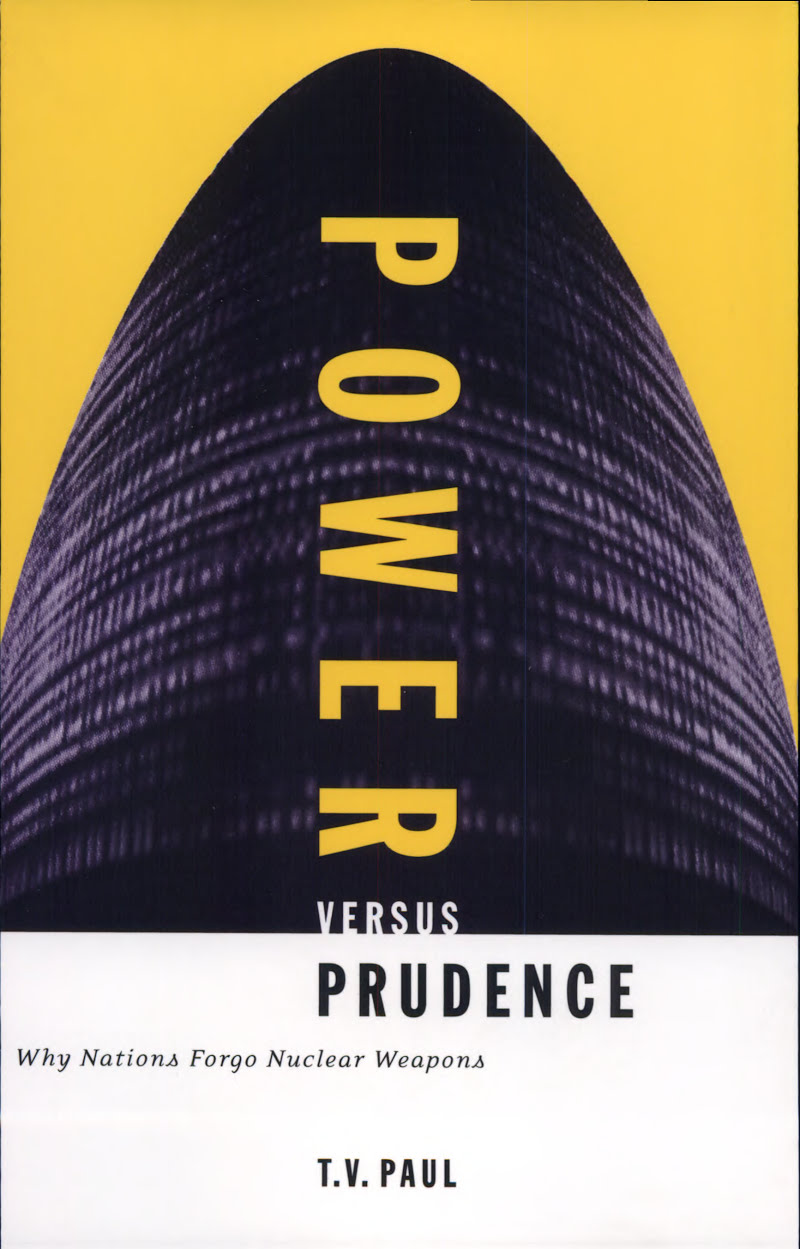
Power Versus Prudence

Power Versus Prudence

Why Nations Forgo Nuclear Weapons

by T.V. Paul, Teleglobe Raoul-Dandurand Chair of Strategic and Diplomatic Studies, Université du Québec à Montréal. Centre d'études des politiques étrangères et de sécurité

227 pages· 2000· ISBN 9780773520875

Browse books you can read free on Readfeed

No club is reading this yet — be the first to start one

Start a club free
About
With the end of the Cold War, nuclear non-proliferation has emerged as a central issue in international security relations. While most existing works on nuclear proliferation deal with the question of nuclear acquisition, T.V. Paul explains why some states – over 185 at present – have decided to forswear nuclear weapons even when they have the technological capability or potential capability to develop them, and why some states already in possession of nuclear arms choose to dismantle them. In Power versus Prudence Paul develops a prudential-realist model, arguing that a nation's national nuclear choices depend on specific regional security contexts: the non-great power states most likely to forgo nuclear weapons are those in zones of low and moderate conflict, while nations likely to acquire such capability tend to be in zones of high conflict and engaged in protracted conflicts and enduring rivalries. He demonstrates that the choice to forbear acquiring nuclear weapons is also a function of the extent of security interdependence that states experience with other states, both allies and adversaries. He applies the comparative case study method to pairs of states with similar characteristics – Germany/Japan, Canada/Australia, Sweden/Switzerland, Argentina/Brazil – in addition to analysing the nuclear choices of South Africa, Ukraine, South Korea, India, Pakistan, and Israel. Paul concludes by questioning some of the prevailing supply side approaches to non-proliferation, offering an explication of the security variable and its linking of nuclear proliferation with protracted conflicts and enduring rivalries. Power versus Prudence will be of interest to students of international relations, policy-makers, policy analysts, and the informed public concerned with the questions of nuclear weapons, non-proliferation, and disarmament. T.V. Paul is an associate professor in the Department of Political Science, McGill University. He has published several books and numerous articles on international security and the politics of nuclear weapons, including Asymmetric Conflicts: War Initiation by Weaker Powers, The Absolute Weapon Revisited: Nuclear Arms and the Emerging International Order, and International Order and the Future of World Politics.

Discuss Power Versus Prudence with other readers

Join or start a book club for Power Versus Prudence on Readfeed. Live chat, shared reading progress, and AI discussion questions — free to get started.

Frequently asked questions

How do I join a book club for Power Versus Prudence?

Sign up free on Readfeed, then browse public clubs or start your own club with Power Versus Prudence as the current read. Invite friends with a share link and discuss together with live chat and AI discussion questions.

Can I discuss Power Versus Prudence with other readers online?

Yes. Readfeed book clubs let you chat live, share progress, and join discussions about Power Versus Prudence with readers worldwide — whether your club is virtual, in-person, or hybrid.

Is Readfeed free?

Yes. Creating an account and joining book clubs is free. Sign up to find readers who love the same books and start discussing today.