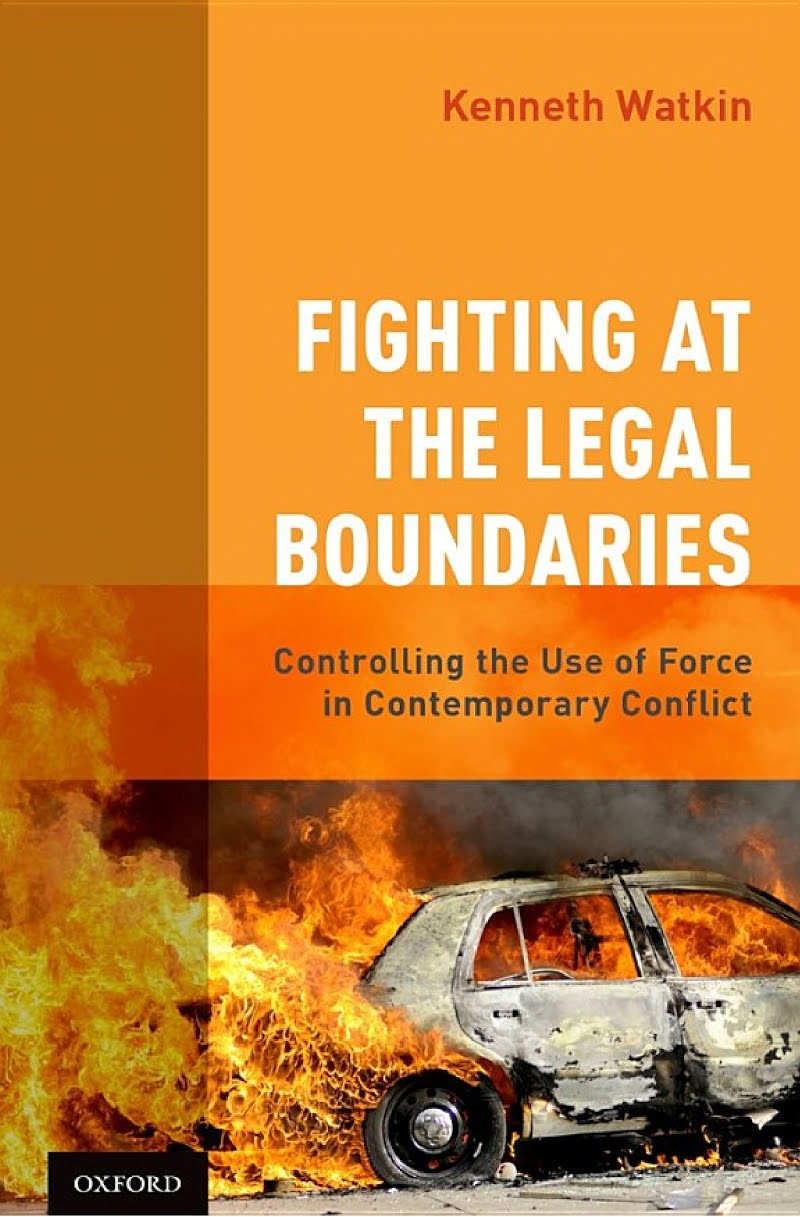
Fighting at the Legal Boundaries

Fighting at the Legal Boundaries

Controlling the Use of Force in Contemporary Conflict

by Kenneth Watkin OMM

456 pages· 2016· ISBN 9780190457990

Browse books you can read free on Readfeed

No club is reading this yet — be the first to start one

Start a club free
About
The international law governing armed conflict is at a crossroads, as the formal framework of laws designed to control the exercise of self-defense and conduct of inter-state conflict finds itself confronted with violent 21st Century disputes of a very different character. Military practitioners who seek to stay within the bounds of international law often find themselves applying bodies of law-IHRL, IHL, ICL-in an exclusionary fashion, and adherence to those boundaries can lead to a formal and often rigid application of the law that does not adequately address contemporary security challenges. Fighting at the Legal Boundaries offers a holistic approach towards the application of the various constitutive parts of international law. The author focuses on the interaction between the applicable bodies of law by exploring whether their boundaries are improperly drawn, or are being interpreted in too rigid a fashion. Emphasis is placed on the disconnect that can occur between theory and practice regarding how these legal regimes are applied and interact with one another. Through a number of case studies, Fighting at the Legal Boundaries explores how the threat posed by insurgents, terrorists, and transnational criminal gangs often occurs not only at the point where these bodies of law interact, but also in situations where there is significant overlap. In this regard, the exercise of the longstanding right of States to defend nationals, including the conduct of operations such as hostage rescue, can involve the application of human rights based law enforcement norms to counter threats transcending the conflict spectrum. This book has five parts: Part I sets out the security, legal, and operational challenges of contemporary conflict. Part II focuses on the interaction between the jus ad bellum, humanitarian law and human rights, including an analysis of the historical influences that shaped their application as separate bodies of law. Emphasis is placed on the influence the proper authority principle has had in the human rights based approach being favored when dealing with "criminal" non-State actors during both international and non-international armed conflict. Part III analyzes the threats of insurgency and terrorism, and the state response. This includes exploring their link to criminal activity and the phenomenon of transnational criminal organizations. Part IV addresses the conduct of operations against non-State actors that span the conflict spectrum from inter-state warfare to international law enforcement. Lastly, Part V looks at the way ahead and discusses the approaches that can be applied to address the evolving, diverse and unique security threats facing the international community.

Discuss Fighting at the Legal Boundaries with other readers

Join or start a book club for Fighting at the Legal Boundaries on Readfeed. Live chat, shared reading progress, and AI discussion questions — free to get started.

Frequently asked questions

How do I join a book club for Fighting at the Legal Boundaries?

Sign up free on Readfeed, then browse public clubs or start your own club with Fighting at the Legal Boundaries as the current read. Invite friends with a share link and discuss together with live chat and AI discussion questions.

Can I discuss Fighting at the Legal Boundaries with other readers online?

Yes. Readfeed book clubs let you chat live, share progress, and join discussions about Fighting at the Legal Boundaries with readers worldwide — whether your club is virtual, in-person, or hybrid.

Is Readfeed free?

Yes. Creating an account and joining book clubs is free. Sign up to find readers who love the same books and start discussing today.