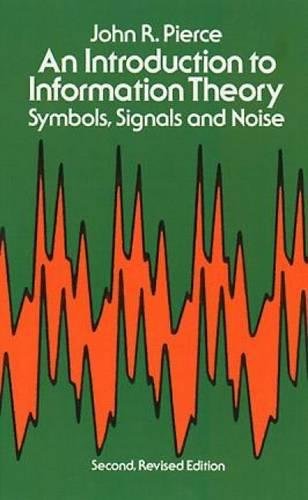
An Introduction to Information Theory: Symbols, Signals and Noise (Dover Books on Mathematics)
Symbols, Signals & Noise
by John R. Pierce, John Robinson Pierce
"Uncommonly good...the most satisfying discussion to be found." — Scientific American.
Behind the familiar surfaces of the telephone, radio, and television lies a sophisticated and intriguing body of knowledge known as information theory. This is the theory that has permitted the rapid development of all sorts of communication, from color television to the clear transmission of photographs from the vicinity of Jupiter. Even more revolutionary progress is expected in the future.
To give a solid introduction to this burgeoning field, J. R. Pierce has revised his well-received 1961 study of information theory for a second edition. Beginning with the origins of the field, Dr. Pierce follows the brilliant formulations of Claude Shannon and describes such aspects of the subject as encoding and binary digits, entropy, language and meaning, efficient encoding, and the noisy channel. He then goes beyond the strict confines of the topic to explore the ways in which information theory relates to physics, cybernetics, psychology, and art. Mathematical formulas are introduced at the appropriate points for the benefit of serious students. A glossary of terms and an appendix on mathematical notation are proved to help the less mathematically sophisticated.
J. R. Pierce worked for many years at the Bell Telephone Laboratories, where he became Director of Research in Communications Principles. His Introduction to Information Theory continues to be the most impressive nontechnical account available and a fascinating introduction to the subject for lay readers.
Discuss An Introduction to Information Theory: Symbols, Signals and Noise (Dover Books on Mathematics) with other readers
Join or start a book club for An Introduction to Information Theory: Symbols, Signals and Noise (Dover Books on Mathematics) on Readfeed. Live chat, shared reading progress, and AI discussion questions — free to get started.
Frequently asked questions
How do I join a book club for An Introduction to Information Theory: Symbols, Signals and Noise (Dover Books on Mathematics)?
Sign up free on Readfeed, then browse public clubs or start your own club with An Introduction to Information Theory: Symbols, Signals and Noise (Dover Books on Mathematics) as the current read. Invite friends with a share link and discuss together with live chat and AI discussion questions.
Can I discuss An Introduction to Information Theory: Symbols, Signals and Noise (Dover Books on Mathematics) with other readers online?
Yes. Readfeed book clubs let you chat live, share progress, and join discussions about An Introduction to Information Theory: Symbols, Signals and Noise (Dover Books on Mathematics) with readers worldwide — whether your club is virtual, in-person, or hybrid.
Is Readfeed free?
Yes. Creating an account and joining book clubs is free. Sign up to find readers who love the same books and start discussing today.