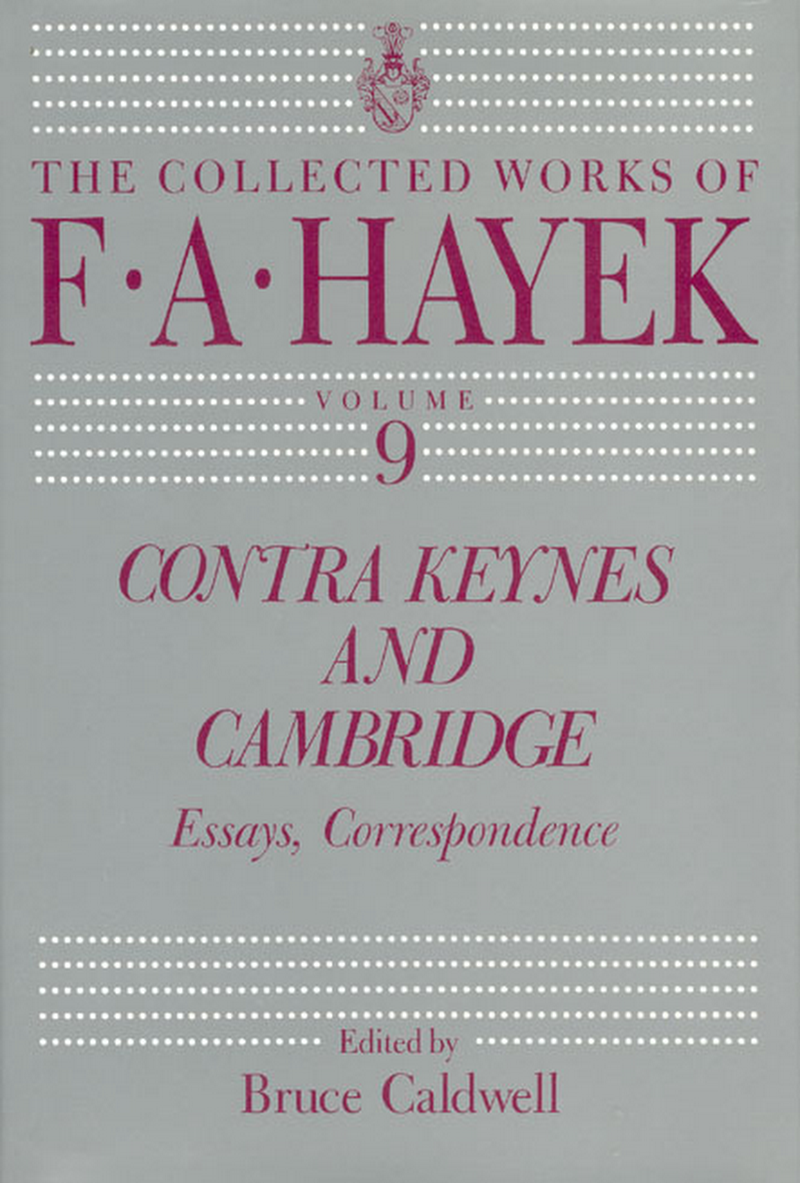
Contra Keynes and Cambridge

Contra Keynes and Cambridge

Essays, Correspondence

by F. A. Hayek, Bruce Caldwell

269 pages· 1995· ISBN 9780226320656

Browse books you can read free on Readfeed

No club is reading this yet — be the first to start one

Start a club free
About
In 1931, when the young F. A. Hayek challenged the economic theories of John Maynard Keynes, sixteen years his senior, and one of the world's leading economists, he sparked a spirited debate that would influence economic policy in democratic countries for decades. Their extensive exchange lasted until Keynes's death in 1946, and is reprinted in its entirety in this latest volume of The Collected Works of F. A. Hayek. When the journal Economica published a review of Keynes's Treatise on Money by Hayek in 1931, Keynes's response consisted principlally of an attack on Hayek's own work on monetary theory, Prices and Production. Conducted almost entirely in economics journals, the battle that followed revealed two very different responses to a world in economic crisis. Keynes sought a revision of the liberal political order—arguing for greater government intervention in the hope of protecting against the painful fluctuations of the business cycle. Hayek instead warned that state involvement would cause irreparable damage to the economy. This volume begins with Hayek's 1963 reminiscence "The Economics of the 1930s as Seen from London," which has never been published before. The articles, letters, and reviews from journals published in the 1930s are followed by Hayek's later reflections on Keynes's work and influence. The Introduction by Bruce Caldwell puts the debate in context, providing detailed information about the economists in Keynes's circle at Cambridge, their role in the acceptance of his ideas, and the ways in which theory affected policy during the interwar period. Caldwell calls the debate between Hayek and Keynes "a battle for the minds of the rising generation of British-trained economists." There is no doubt that Keynes won the battle during his lifetime. Now, when many of Hayek's ideas have been vindicated by the collapse of collectivist economies and the revival of the free market around the world, this book clarifies Hayek's work on monetary theory—formed in heated opposition to Keynes—and illuminates his efforts to fight protectionism in an age of economic crisis. F. A. Hayek (1899-1992), recipient of the Medal of Freedom in 1991 and co-winner of the Nobel Memorial Prize in Economics in 1974, was a pioneer in monetary theory and the principal proponent of classical liberal thought in the twentieth century. He taught at the University of London, the University of Chicago, and the University of Freiburg.

Discuss Contra Keynes and Cambridge with other readers

Join or start a book club for Contra Keynes and Cambridge on Readfeed. Live chat, shared reading progress, and AI discussion questions — free to get started.

Frequently asked questions

How do I join a book club for Contra Keynes and Cambridge?

Sign up free on Readfeed, then browse public clubs or start your own club with Contra Keynes and Cambridge as the current read. Invite friends with a share link and discuss together with live chat and AI discussion questions.

Can I discuss Contra Keynes and Cambridge with other readers online?

Yes. Readfeed book clubs let you chat live, share progress, and join discussions about Contra Keynes and Cambridge with readers worldwide — whether your club is virtual, in-person, or hybrid.

Is Readfeed free?

Yes. Creating an account and joining book clubs is free. Sign up to find readers who love the same books and start discussing today.