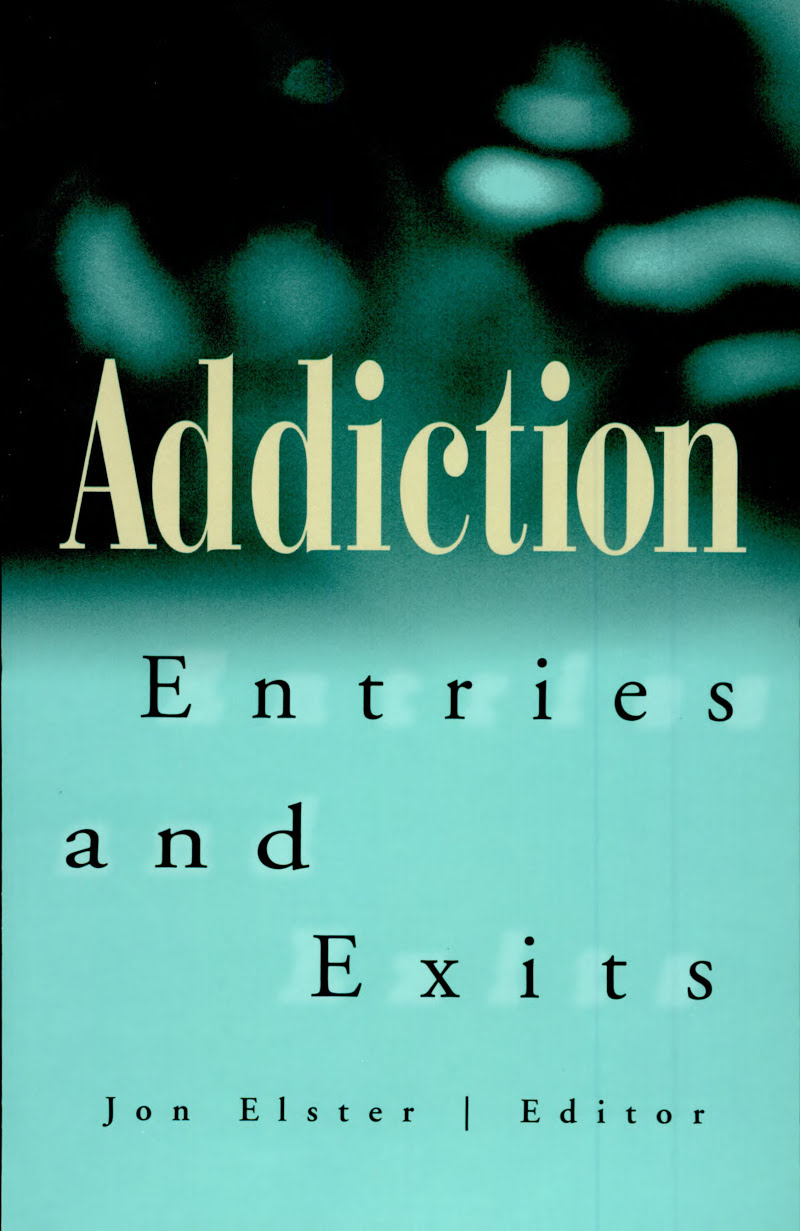
Addiction
Entries and Exits
by Jon Elster
310 pages· 1999· ISBN 9780871542359
About
Addiction focuses on the emergence, nature, and persistence of addictive behavior, as well as the efforts of addicts to overcome their condition. Do addicts act of their own free will, or are they driven by forces beyond their control? Do structured treatment programs offer more hope for recovery? What causes relapses to occur? Recent scholarship has focused attention on the voluntary aspects of addiction, particularly the role played by choice. Addiction draws upon this new research and the investigations of economists, psychiatrists, philosophers, neuropharmacologists, historians, and sociologists to offer an important new approach to our understanding of addictive behavior. The notion that addicts favor present rewards over future gains or penalties echoes throughout the chapters in Addiction. The effect of cultural values and beliefs on addicts, and on those who treat them, is also explored, particularly in chapters by Elster on alcoholism and by Acker on American heroin addicts in the 1920s and 1930s. Essays by Gardner and by Waal and Mørland discuss the neurobiological roots of addiction Among their findings are evidence that addictive drugs also have an important effect on areas of the central nervous system unrelated to euphoria or dysphoria, and that tolerance and withdrawal phenomena vary greatly from drug to drug. The plight of addicts struggling to regain control of their lives receives important consideration in Addiction. Elster, Skog, and O'Donoghue and Rabin look at self-administered therapies ranging from behavioral modifications to cognitive techniques, and discuss conditions under which various treatment strategies work. Drug-based forms of treatment are discussed by Gardner, drawing on work that suggests that parts of the population have low levels of dopamine, inducing a tendency toward sensation-seeking. There are many different explanations for the impulsive, self-destructive behavior that is addiction. By bringing the triple perspective of neurobiology, choice, and culture to bear on the phenomenon, Addiction offers a unique and valuable source of information and debate on a problem of world-wide proportions.
Discuss Addiction with other readers
Join or start a book club for Addiction on Readfeed. Live chat, shared reading progress, and AI discussion questions — free to get started.
Frequently asked questions
How do I join a book club for Addiction?
Sign up free on Readfeed, then browse public clubs or start your own club with Addiction as the current read. Invite friends with a share link and discuss together with live chat and AI discussion questions.
Can I discuss Addiction with other readers online?
Yes. Readfeed book clubs let you chat live, share progress, and join discussions about Addiction with readers worldwide — whether your club is virtual, in-person, or hybrid.
Is Readfeed free?
Yes. Creating an account and joining book clubs is free. Sign up to find readers who love the same books and start discussing today.