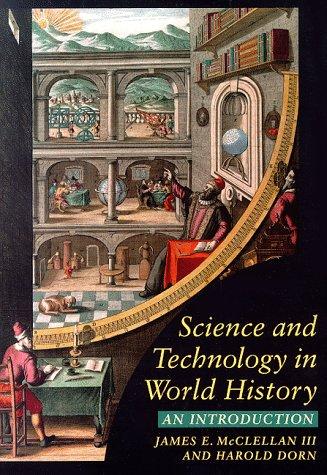
Science and technology in world history

Science and technology in world history

by Harold Dorn, domenico E. III bertoloni meli, James E. McClellan III

1999
4.0(6)
avg. reader rating
Rate this book:

Browse books you can read free on Readfeed

No club is reading this yet — be the first to start one

72 readers worldwide want to read this book

Start a club free
About
In modern industrial society, the tie between science and technology seems clear, even inevitable. But historically, as James E. McClellan III and Harold Dorn remind us, the connection has been far less apparent. For much of human history, technology depended more on the innovation of skilled artisans than it did on the speculation of scientists. Technology as "applied science," the authors argue, emerged relatively recently, as industry and governments began funding scientific research that would lead directly to new or improved technologies. In Science and Technology in World History, McClellan and Dorn offer an introduction to this changing relationship. McClellan and Dorn review the historical record beginning with the thinking and tool making of prehistoric humans. Neolithic people, for example, developed metallurgy of a sort, using naturally occurring raw copper, and kept systematic records of the moon's phases. Neolithic craftsmen possessed practical knowledge of the behavior of clay, fire, and other elements of their environment, but though they may have had explanations for the phenomena of their crafts, they toiled without any systematic science of materials or the self-conscious application of theory to practice. McClellan and Dorn identify two great scientific traditions: the useful sciences, patronized by the state from the dawn of civilization, and scientific theorizing, initiated by the ancient Greeks. Theirs is a survey of the historical twists and turns of these traditions, leading to the science of our own day. Without neglecting important figures of Western science such as Newton and Einstein, the authors demonstrate the great achievements of non-Western cultures. They remind us that scientific traditions took root in China, India, and Central and South America, as well as in a series of Near Eastern empires, during late antiquity and the Middle Ages, including the vast region that formed the Islamic conquest. From this comparative perspective, the authors explore the emergence of Europe as a scientific and technological power. Continuing their narrative through the Manhattan Project, NASA, and modern medical research, the authors weave the converging histories of science and technology into an integrated, perceptive, and highly readable narrative.

Discuss Science and technology in world history with other readers

Join or start a book club for Science and technology in world history on Readfeed. Live chat, shared reading progress, and AI discussion questions — free to get started.

Frequently asked questions

How do I join a book club for Science and technology in world history?

Sign up free on Readfeed, then browse public clubs or start your own club with Science and technology in world history as the current read. Invite friends with a share link and discuss together with live chat and AI discussion questions.

Can I discuss Science and technology in world history with other readers online?

Yes. Readfeed book clubs let you chat live, share progress, and join discussions about Science and technology in world history with readers worldwide — whether your club is virtual, in-person, or hybrid.

Is Readfeed free?

Yes. Creating an account and joining book clubs is free. Sign up to find readers who love the same books and start discussing today.