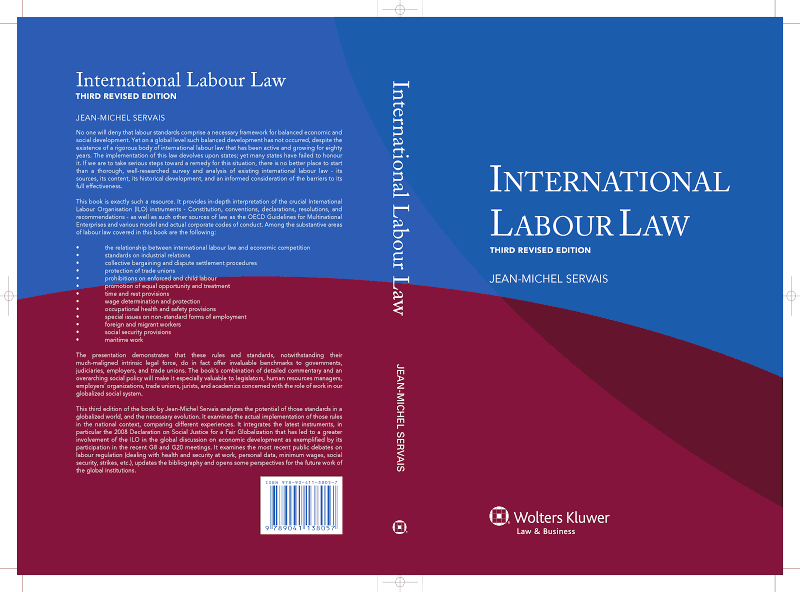
International Labour Law
by Jean-Michel Servais
372 pages· 2011· ISBN 9789041138057
About
No one will deny that labour standards comprise a necessary framework for balanced economic and social development. Yet on a global level such balanced development has not occurred, despite the existence of a rigorous body of international labour law that has been active and growing for eighty years. The implementation of this law devolves upon states; yet many states have failed to honour it. If we are to take serious steps toward a remedy for this situation, there is no better place to start than a thorough, well-researched survey and analysis of existing international labour law - its sources, its content, its historical development, and an informed consideration of the barriers to its full effectiveness. This book is exactly such a resource. It provides in-depth interpretation of the crucial International Labour Organisation (ILO) instruments - Constitution, conventions, declarations, resolutions, and recommendations - as well as such other sources of law as the OECD Guidelines for Multinational Enterprises and various model and actual corporate codes of conduct. Among the substantive areas of labour law covered in this book are the following: the relationship between international labour law and economic competition standards on industrial relations collective bargaining and dispute settlement procedures protection of trade unions prohibitions on enforced and child labour promotion of equal opportunity and treatment time and rest provisions wage determination and protection occupational health and safety provisions special issues on non-standard forms of employment foreign and migrant workers social security provisions maritime work The presentation demonstrates that these rules and standards, notwithstanding their much-maligned intrinsic legal force, do in fact offer invaluable benchmarks to governments, judiciaries, employers, and trade unions. The book's combination of detailed commentary and an overarching social policy will make it especially valuable to legislators, human resources managers, employers´ organizations, trade unions, jurists, and academics concerned with the role of work in our globalised social system. This second edition of the book by Jean-Michel Servais analyzes the potential of those standards in a globalized world, and the necessary evolution. It examines the actual implementation of those rules in the national context, comparing different experiences.
Discuss International Labour Law with other readers
Join or start a book club for International Labour Law on Readfeed. Live chat, shared reading progress, and AI discussion questions — free to get started.
Frequently asked questions
How do I join a book club for International Labour Law?
Sign up free on Readfeed, then browse public clubs or start your own club with International Labour Law as the current read. Invite friends with a share link and discuss together with live chat and AI discussion questions.
Can I discuss International Labour Law with other readers online?
Yes. Readfeed book clubs let you chat live, share progress, and join discussions about International Labour Law with readers worldwide — whether your club is virtual, in-person, or hybrid.
Is Readfeed free?
Yes. Creating an account and joining book clubs is free. Sign up to find readers who love the same books and start discussing today.