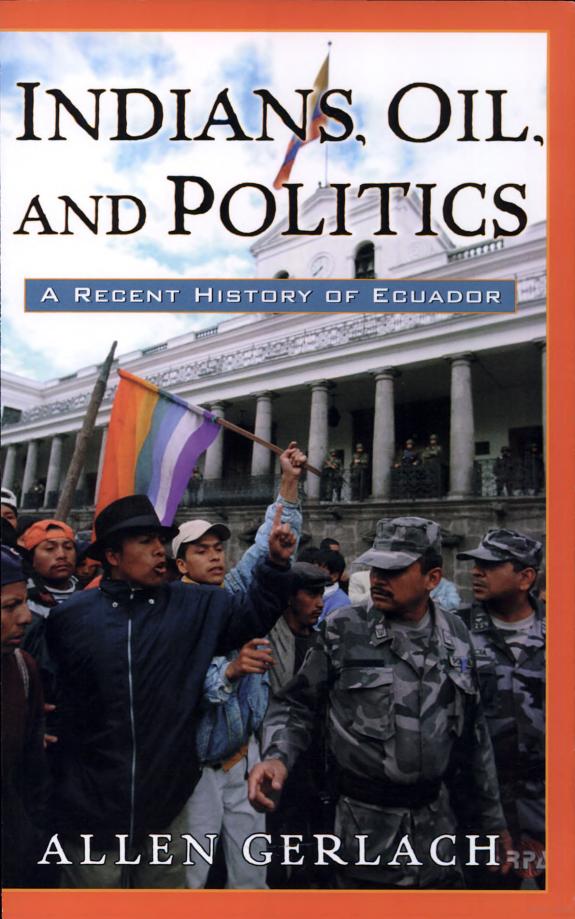
Indians, Oil, and Politics

Indians, Oil, and Politics

A Recent History of Ecuador

by Allen Gerlach

286 pages· 2003· ISBN 9780842051088

Browse books you can read free on Readfeed

No club is reading this yet — be the first to start one

Start a club free
About
'It is indispensable that Ecuador has peace, but to have peace you need freedom and to have freedom you need justice. And the Indian population needs justice.'-President Gustavo Noboa, January 23, 2000 For five centuries, the Indians had very little voice in Ecuador. Now they are major protagonists who seek more acceptable terms in which to coexist in a society with two vastly different world views and cultures-that of Indians and that of the descendants of Europeans. Their recent political uprising has become the most powerful and influential indigenous movement in Latin America. They have inspired other Indian movements throughout the continent. Author Allen Gerlach details the origins and evolution of the Indian rebellion, focusing on the key period of the last thirty years. In the process, he also presents a concise political history of Ecuador. Gerlach infuses his text with an abundant supply of quotations from participants in the rise in ethnic politics, bringing Ecuador's history and the Indians' opposition to the country's government to life. In addition, Indians, Oil, and Politics serves as a case study on what happens to a nation when its economy is based solely on one commodity-in this instance, oil. The discovery of oil in the Amazon in 1967 was a major factor in Ecuador's modernization and also sparked the Indians' fight for their rights. Oil wealth wreaked havoc on the environment and cultures of the native people of the Amazon, and it did not end old traditions of political fragmentation and corruption. Gerlach explains that the Indians fought back by forming federations to advance their interests and by joining forces with similar structures molded in the highlands of Ecuador. Together they created the country's first truly national indigenous organization in 1986-CONAIE (The Confederation of Indigenous Nationalities of Ecuador)-and by 2000 their movement was a major force to be reckoned with, one which increasingly influenced state policy. This book shows how the Indians helped bring down two governments when massive demonstrations led to the fall of two regimes in 1997 and 2000. The Indians battled for economic advancement, but above all demanded respect for the dignity of their culture and for their moral and historical rights to their lands and territories. This valuable case study of the politics of ethnicity will become increasingly useful for those interested in Latin American politics.

Discuss Indians, Oil, and Politics with other readers

Join or start a book club for Indians, Oil, and Politics on Readfeed. Live chat, shared reading progress, and AI discussion questions — free to get started.

Frequently asked questions

How do I join a book club for Indians, Oil, and Politics?

Sign up free on Readfeed, then browse public clubs or start your own club with Indians, Oil, and Politics as the current read. Invite friends with a share link and discuss together with live chat and AI discussion questions.

Can I discuss Indians, Oil, and Politics with other readers online?

Yes. Readfeed book clubs let you chat live, share progress, and join discussions about Indians, Oil, and Politics with readers worldwide — whether your club is virtual, in-person, or hybrid.

Is Readfeed free?

Yes. Creating an account and joining book clubs is free. Sign up to find readers who love the same books and start discussing today.