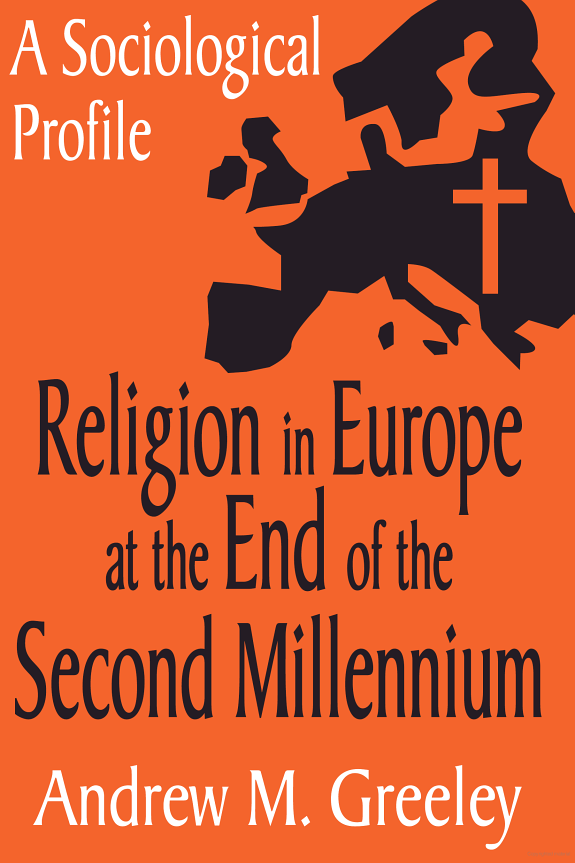
Religion in Europe at the End of the Second Millennium

Religion in Europe at the End of the Second Millennium

A Sociological Profile

by Andrew M. Greeley

252 pages· 2004· ISBN 9781412832984

Browse books you can read free on Readfeed

No club is reading this yet — be the first to start one

Start a club free
About
Most sociologists of religion describe a general decline in religious faith and practice in Europe over the last two centuries. The secularizing forces of the Enlightenment, science, industrialization, the influence of Freud and Marx, and urbanization are all felt to have diminished the power of the churches and demystified the human condition. In Andrew Greeley's view, such overarching theories and frameworks do not begin to accommodate a wide variety of contrasting and contrary social phenomena. Religion at the End of the Second Millenium, engages the complexities of contemporary Europe to present a nuanced picture of religious faith rising, declining, or remaining stable. While challenging the secularization model, Greeley's approach is not polemical. He examines belief in God and in life after death, belief in superstition and magic, convictions about the relations between church and state, attitudes toward religion and science, and the effect of religion on the everyday lives of people. Drawing upon statistical and empirical data spanning twenty years, Greeley shows that while religion has increased in some countries (most notably the former communist countries and especially Russia) in others it has declined (Britain, the Netherlands, and France). In some countries it is relatively unchanged (primarily the traditional Catholic countries), and in still others (some of the social democratic countries) it has both declined and increased. In terms of individuals, Greeley finds that religion becomes more important to people as they age. He observes that surveys showing less religion among the young ignore the possibility that the age correlation is a life cycle matter and not a sign of social change. Patently, religion in Europe changed enormously between the end of the first millenium and the end of the second. In Greeley's judgment, the change has been an improvement, not because superstition has been eliminated (it has not), but because freedom to exercise religious belief has replaced compulsion.

Discuss Religion in Europe at the End of the Second Millennium with other readers

Join or start a book club for Religion in Europe at the End of the Second Millennium on Readfeed. Live chat, shared reading progress, and AI discussion questions — free to get started.

Frequently asked questions

How do I join a book club for Religion in Europe at the End of the Second Millennium?

Sign up free on Readfeed, then browse public clubs or start your own club with Religion in Europe at the End of the Second Millennium as the current read. Invite friends with a share link and discuss together with live chat and AI discussion questions.

Can I discuss Religion in Europe at the End of the Second Millennium with other readers online?

Yes. Readfeed book clubs let you chat live, share progress, and join discussions about Religion in Europe at the End of the Second Millennium with readers worldwide — whether your club is virtual, in-person, or hybrid.

Is Readfeed free?

Yes. Creating an account and joining book clubs is free. Sign up to find readers who love the same books and start discussing today.