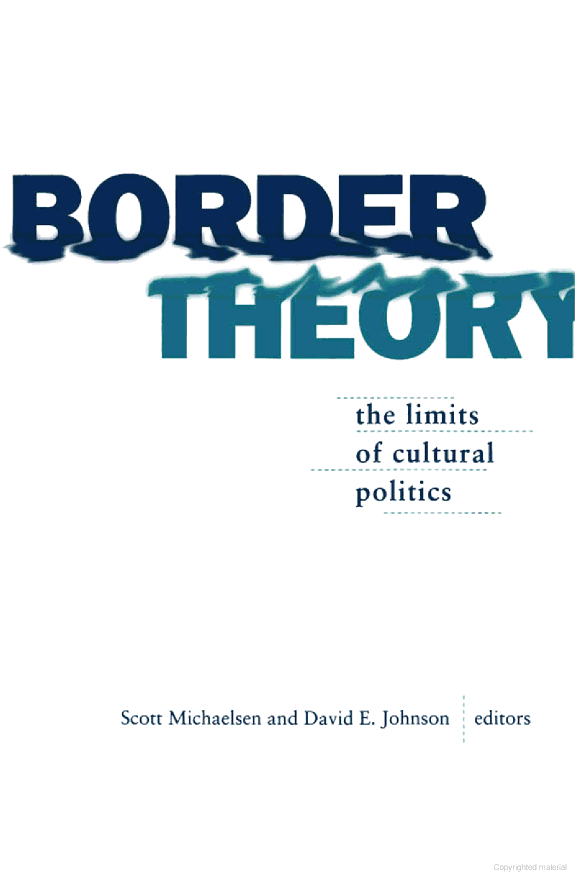
Border Theory
The Limits of Cultural Politics
by David E. Johnson, Scott Michaelsen
266 pages· 1997· ISBN 9780816629633
About
Border Theory was first published in 1997. Minnesota Archive Editions uses digital technology to make long-unavailable books once again accessible, and are published unaltered from the original University of Minnesota Press editions. Challenging the prevailing assumption that border studies occurs only in "the borderlands" where Mexico and the United States meet, the authors gathered in this volume examine the multiple borders that define the United States and the Americas, including the Mason-Dixon line, the U.S.- Canadian border, the shifting boundaries of urban diasporas, and the colonization and confinement of American Indians. The texts assembled here examine the way border studies beckons us to rethink all objects of study and intellectual disciplines as versions of a border problematic. These writers-drawn from anthropology, history, and language studies-critique the terrain, limits, and possibilities of border theory. They examine, among other topics, the "soft" or "friendly" borders produced by ethnic studies, antiassimilationist or "difference" multiculturalisms, liberal anthropologies, and benevolent nationalisms. Referring to a range of theory (anthropological, sociological, feminist, Marxist, European postmodernist and poststructuralist, postcolonial, and ethnohistorical), the authors trace the genealogical and logical links between these discourses and border studies. A timely critique of a field just now revealing its explosive potential, this volume maps the intellectual topography of border theory and challenges the epistemological and political foundations of border studies. Contributors are Russ Castronovo, Elaine K. Chang, Louis Kaplan, Alejandro Lugo, Benjamin Alire Sáenz, and Patricia Seed. Scott Michaelsen is assistant professor of English at Michigan State University. David E. Johnson is lecturer in the Department of Modern Languages at the State University of New York at Buffalo.
Discuss Border Theory with other readers
Join or start a book club for Border Theory on Readfeed. Live chat, shared reading progress, and AI discussion questions — free to get started.
Frequently asked questions
How do I join a book club for Border Theory?
Sign up free on Readfeed, then browse public clubs or start your own club with Border Theory as the current read. Invite friends with a share link and discuss together with live chat and AI discussion questions.
Can I discuss Border Theory with other readers online?
Yes. Readfeed book clubs let you chat live, share progress, and join discussions about Border Theory with readers worldwide — whether your club is virtual, in-person, or hybrid.
Is Readfeed free?
Yes. Creating an account and joining book clubs is free. Sign up to find readers who love the same books and start discussing today.