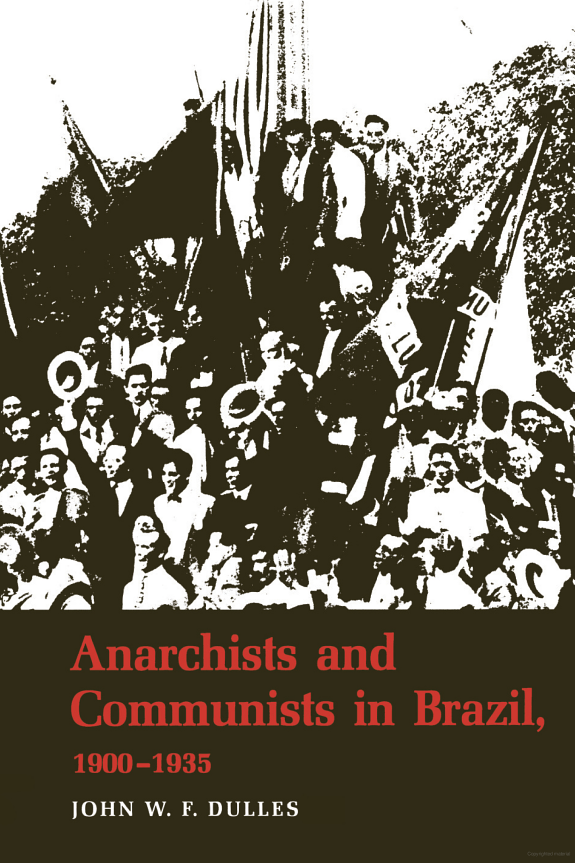
In providing a detailed account of the leftist opposition and its bloody repression in Brazil during the Old Republic and the early years of the Vargas regime, John W. F. Dulles gives considerable attention to the labor movement, generally neglected by historians. This study focuses on the formation and activities of anarchists and Communists, the two most important radical groups working within Brazilian labor. Relying on a wide variety of sources, including interviews and personal papers, Dulles supplies information that for the most part is unavailable in English and not easily accessible in Portuguese. The struggles of Brazilian workers—usually against an alliance of company owners, state and federal troops, and state and federal governments—suffered reverses in 1920 and 1921. These setbacks were cited by Astrogildo Pereira and other admirers of Bolshevism as reasons for the proletariat to forsake anarchism and adhere to the Communist Party, Brazilian Section of the Communist International. Anarchists and Communists, struggling against each other in the labor unions in the mid 1920’s, joined opposition journalists and politicians in supporting military rebels in a romantic uprising marked by adventure and suffering, jailbreaks and long marches, and death in the backlands. Slowly, Brazilian Communism gained strength during the latter part of the 1920’s, but 1930 brought the beginnings of failure. Worse for the Party than the government crackdown and the Trotskyite dissidence was the growing attraction of the Aliança Liberal, the oppositionist political movement that brought Getúlio Vargas to power. While workers and Party members flocked to the Aliança in defiance of Party orders, sectarian edicts from Moscow resulted in the expulsion or demotion of the Party’s former leaders and in the condemnation of intellectuals. Luís Carlos Prestes, “the Cavalier of Hope” who had led the military rebels in the mid-1920’s, turned to Communism—only to find himself not welcome in the Party. Taken to Russia by the Communist International in 1931, he was finally accepted into the Brazilian Party in absentia in 1934. Later that year, misled in Moscow by optimistic reports brought by Brazilian Communists, he agreed to lead a rebellion in Brazil. That decision and its consequences in 1935 were disastrous to Brazilian Communism. The struggles among anarchists, Stalinists, and Trotskyites in Brazil were reflections of a worldwide struggle. This study discloses and assesses the effects of Moscow policy changes on Communism in Brazil and contributes to an understanding of Moscow’s policies throughout Latin America during this period.