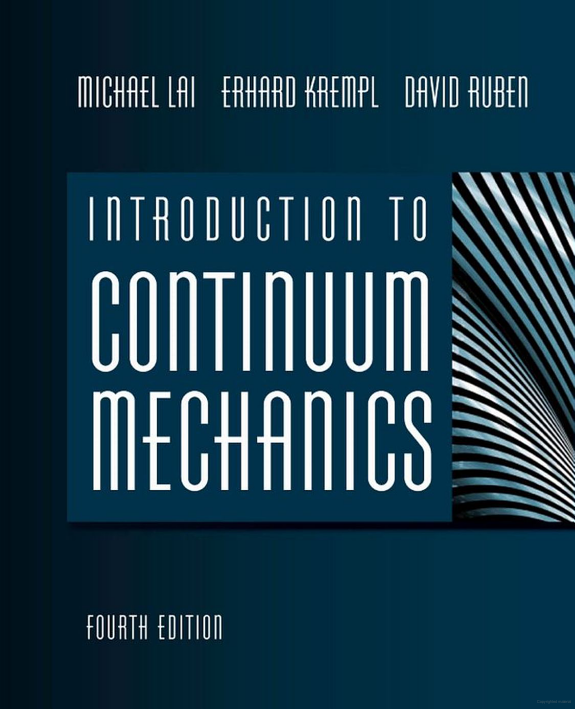
Introduction to Continuum Mechanics

Introduction to Continuum Mechanics

by David Rubin, W Michael Lai, David H. Rubin, Erhard Krempl

536 pages· 2009· ISBN 9780080942520
About
Continuum Mechanics is a branch of physical mechanics that describes the macroscopic mechanical behavior of solid or fluid materials considered to be continuously distributed. It is fundamental to the fields of civil, mechanical, chemical and bioengineering. This time-tested text has been used for over 35 years to introduce junior and senior-level undergraduate engineering students, as well as graduate students, to the basic principles of continuum mechanics and their applications to real engineering problems. The text begins with a detailed presentation of the coordinate invariant quantity, the tensor, introduced as a linear transformation. This is then followed by the formulation of the kinematics of deformation, large as well as very small, the description of stresses and the basic laws of continuum mechanics. As applications of these laws, the behaviors of certain material idealizations (models) including the elastic, viscous and viscoelastic materials, are presented. This new edition offers expanded coverage of the subject matter both in terms of details and contents, providing greater flexibility for either a one or two-semester course in either continuum mechanics or elasticity. Although this current edition has expanded the coverage of the subject matter, it nevertheless uses the same approach as that in the earlier editions - that one can cover advanced topics in an elementary way that go from simple to complex, using a wealth of illustrative examples and problems. It is, and will remain, one of the most accessible textbooks on this challenging engineering subject. Significantly expanded coverage of elasticity in Chapter 5, including solutions of some 3-D problems based on the fundamental potential functions approach. New section at the end of Chapter 4 devoted to the integral formulation of the field equations Seven new appendices appear at the end of the relevant chapters to help make each chapter more self-contained Expanded and improved problem sets providing both intellectual challenges and engineering applications

Discuss Introduction to Continuum Mechanics with other readers

Join or start a book club for Introduction to Continuum Mechanics on Readfeed. Live chat, shared reading progress, and AI discussion questions — free to get started.

Frequently asked questions

How do I join a book club for Introduction to Continuum Mechanics?

Sign up free on Readfeed, then browse public clubs or start your own club with Introduction to Continuum Mechanics as the current read. Invite friends with a share link and discuss together with live chat and AI discussion questions.

Can I discuss Introduction to Continuum Mechanics with other readers online?

Yes. Readfeed book clubs let you chat live, share progress, and join discussions about Introduction to Continuum Mechanics with readers worldwide — whether your club is virtual, in-person, or hybrid.

Is Readfeed free?

Yes. Creating an account and joining book clubs is free. Sign up to find readers who love the same books and start discussing today.