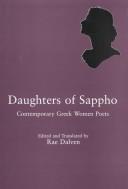
Daughters of Sappho
by Rae Dalven
Rate this book:
No club is reading this yet — be the first to start one
About
Daughters of Sappho is an anthology of twenty-five contemporary Greek women poets, represented by some of their best poems in new translations by Rae Dalven. Presenting the poets in chronological order and providing full biographical and bibliographical accounts of them, this collection shows the gradual development of Greek women's verse from sentimental romanticism to various forms of modernism and post-modernism.
In the first two decades of this century, poetry was identified with male literature, and Greek women poets were discriminated against by this patriarchal society. Maria Polydhouri (1902-30) wrote romantic and erotic poetry because love was the only subject acceptable for women. She is included in this anthology because she was the first contemporary Greek woman poet to gain prominence beyond the borders of Greece.
The thirties, on the other hand, were a period of social fragmentation and political chaos, and a period of unexpected change in poetry, inspired by George Seferis and Odysseus Elytis. Seferis, the most distinguished poet of the period, bound his classical heritage to the tragic fate of his own generation in demotic speech and free verse. It was also the time when the literary magazine Nea Grammata gave support to the new tendencies in poetry.
.
During these years, a new type of woman poet emerged, determined to combat the intellectual decadence and poetic sterility of the time. To achieve their identity as poets, and as citizens in a man's world, they emulated Sappho for her language, the free expression of her emotions, and her dedication to the pursuit of individual freedom for women. They re-evaluated their familiar classic myths and applied them to their own contemporary world.
It was during the thirties that most of these contemporary Greek woman poets broke forever from the shackles of meter and rhyme and wrote in free verse, and in the demotic language. They also turned their attention to the European scene to broaden their poetic outlook. Some assimilated Freud's approach for the release of the unconscious; others pursued the teachings of Heidegger and Kierkegaard. The poet Olga Votsi was influenced by the teachings of Holderlin; Melissanthi found answers to her metaphysical questions in Jung and Berdya'ev.
The political struggles that Greece has undergone in this century (the German occupation in World War II, the traumatic Civil War of 1944-49, the totalitarian rule of 1967-74) also cannot be ignored: the women poets took the lead in stimulating the national conscience, protesting oppression, and fighting for women's rights.
Whichever philosophy these poets innately believed in, and however the reactionary measures sought to repress them, they continue to look to Sappho for her language, her lyricism, and her social purpose to achieve equality and freedom as poets in a man's world.
Discuss Daughters of Sappho with other readers
Join or start a book club for Daughters of Sappho on Readfeed. Live chat, shared reading progress, and AI discussion questions — free to get started.
Frequently asked questions
How do I join a book club for Daughters of Sappho?
Sign up free on Readfeed, then browse public clubs or start your own club with Daughters of Sappho as the current read. Invite friends with a share link and discuss together with live chat and AI discussion questions.
Can I discuss Daughters of Sappho with other readers online?
Yes. Readfeed book clubs let you chat live, share progress, and join discussions about Daughters of Sappho with readers worldwide — whether your club is virtual, in-person, or hybrid.
Is Readfeed free?
Yes. Creating an account and joining book clubs is free. Sign up to find readers who love the same books and start discussing today.