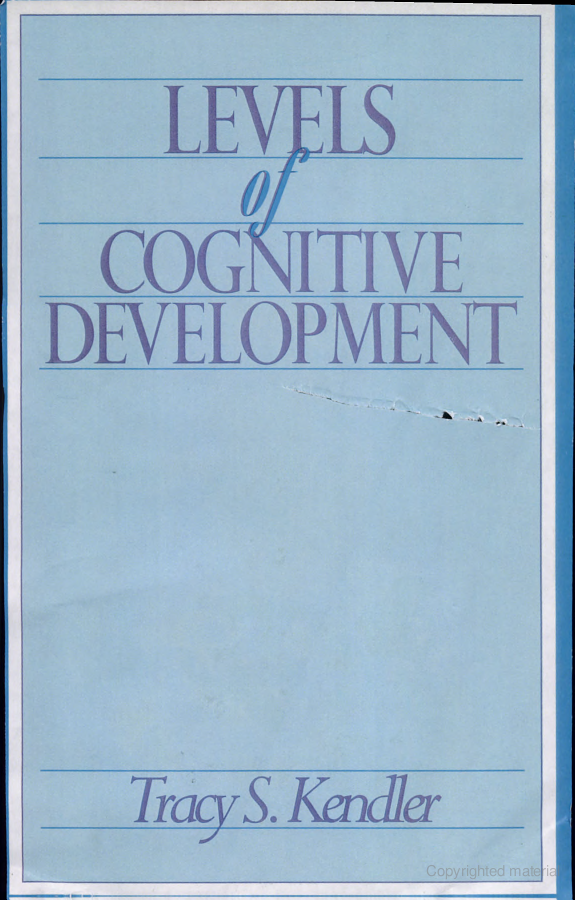
Levels of Cognitive Development

Levels of Cognitive Development

by Tracy S. Kendler

187 pages· 1995· ISBN 9780805806809

Browse books you can read free on Readfeed

No club is reading this yet — be the first to start one

Start a club free
About
The proposed levels theory presented in this book concerns some developmental changes in the capacity to selectively encode information and provide rational solutions to problems. These changes are measured by the behavior exhibited in simple discrimination-learning problems that allow both for information to be encoded either selectively or nonselectively and for solutions to be produced by associative learning or by hypothesis-testing. The simplicity of these problems permits comparisons between infrahuman and human performance and also between a wide range of ages among humans. Human adults presented with these problems typically encode the relevant information selectively and solve the problems in a rational mode. Infrahuman animals, however, typically process the information nonselectively and solve the problems in an automatic, associative mode. How human children encode the information and solve the problems depends on their age. The youngest children -- like the infrahuman animals -- mostly encode the information nonselectively and solve the problems in the associative mode. But between early childhood and young adulthood there is a gradual, long-term, quantifiable increase in the tendency to encode the information selectively and to solve the problem by testing plausible hypotheses. The theory explains in some detail the structure, function, development, and operation of the psychological system that produces both the ontogenetic and phylogenetic differences. This system is assumed to be differentiated into an information-processing system and an executive system analogous to the differentiation of the nervous system into afferent and efferent systems. Each of these systems is further differentiated into structural levels, with the higher level, in part, duplicating the function of the lower level, but in a more plastic, voluntary, and efficient manner. The differentiation of the information-processing and executive systems into different functional levels is presumed to have occurred sometime during the evolution of mankind with the higher level evolving later than the lower one as the central nervous system became increasing encephalized. As for human ontogeny, the higher levels are assumed to develop later and more slowly than their lower-level counterparts. In addition to accounting for a substantial body of empirical data, the theory resolves some recurrent controversies that have bedeviled psychology since its inception as a science. It accomplishes this by showing how information can be both nonselectively and selectively encoded, how automatic associative learning and rational problem-solving can operate in harmony, and how cognitive development can be both qualitative and quantitative.

Discuss Levels of Cognitive Development with other readers

Join or start a book club for Levels of Cognitive Development on Readfeed. Live chat, shared reading progress, and AI discussion questions — free to get started.

Frequently asked questions

How do I join a book club for Levels of Cognitive Development?

Sign up free on Readfeed, then browse public clubs or start your own club with Levels of Cognitive Development as the current read. Invite friends with a share link and discuss together with live chat and AI discussion questions.

Can I discuss Levels of Cognitive Development with other readers online?

Yes. Readfeed book clubs let you chat live, share progress, and join discussions about Levels of Cognitive Development with readers worldwide — whether your club is virtual, in-person, or hybrid.

Is Readfeed free?

Yes. Creating an account and joining book clubs is free. Sign up to find readers who love the same books and start discussing today.