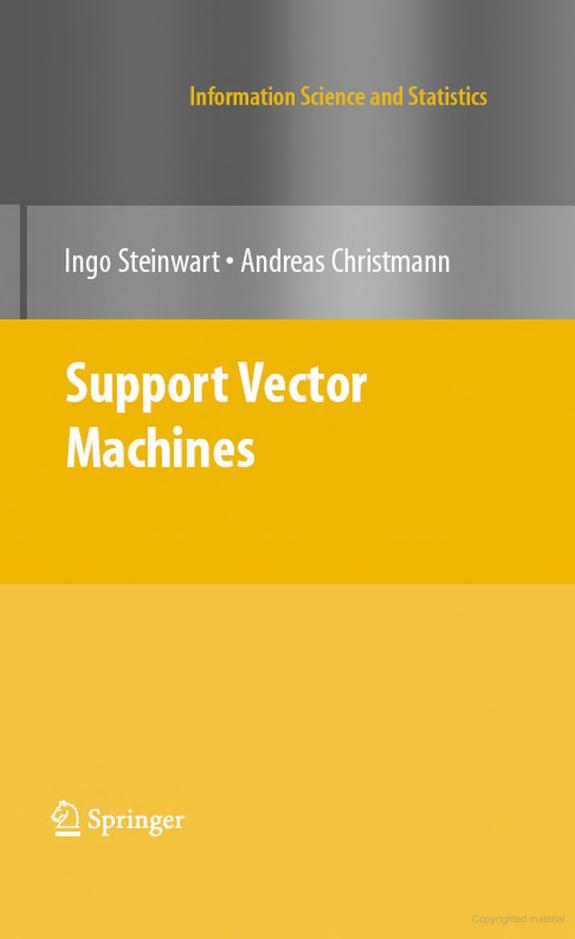
Support Vector Machines
by Ingo Steinwart, Andreas Christmann
601 pages· 2008· ISBN 9780387772424
About
Every mathematical discipline goes through three periods of development: the naive, the formal, and the critical. David Hilbert The goal of this book is to explain the principles that made support vector machines (SVMs) a successful modeling and prediction tool for a variety of applications. We try to achieve this by presenting the basic ideas of SVMs together with the latest developments and current research questions in a uni?ed style. In a nutshell, we identify at least three reasons for the success of SVMs: their ability to learn well with only a very small number of free parameters, their robustness against several types of model violations and outliers, and last but not least their computational e?ciency compared with several other methods. Although there are several roots and precursors of SVMs, these methods gained particular momentum during the last 15 years since Vapnik (1995, 1998) published his well-known textbooks on statistical learning theory with aspecialemphasisonsupportvectormachines. Sincethen,the?eldofmachine learninghaswitnessedintenseactivityinthestudyofSVMs,whichhasspread moreandmoretootherdisciplinessuchasstatisticsandmathematics. Thusit seems fair to say that several communities are currently working on support vector machines and on related kernel-based methods. Although there are many interactions between these communities, we think that there is still roomforadditionalfruitfulinteractionandwouldbegladifthistextbookwere found helpful in stimulating further research. Many of the results presented in this book have previously been scattered in the journal literature or are still under review. As a consequence, these results have been accessible only to a relativelysmallnumberofspecialists,sometimesprobablyonlytopeoplefrom one community but not the others.
Discuss Support Vector Machines with other readers
Join or start a book club for Support Vector Machines on Readfeed. Live chat, shared reading progress, and AI discussion questions — free to get started.
Frequently asked questions
How do I join a book club for Support Vector Machines?
Sign up free on Readfeed, then browse public clubs or start your own club with Support Vector Machines as the current read. Invite friends with a share link and discuss together with live chat and AI discussion questions.
Can I discuss Support Vector Machines with other readers online?
Yes. Readfeed book clubs let you chat live, share progress, and join discussions about Support Vector Machines with readers worldwide — whether your club is virtual, in-person, or hybrid.
Is Readfeed free?
Yes. Creating an account and joining book clubs is free. Sign up to find readers who love the same books and start discussing today.