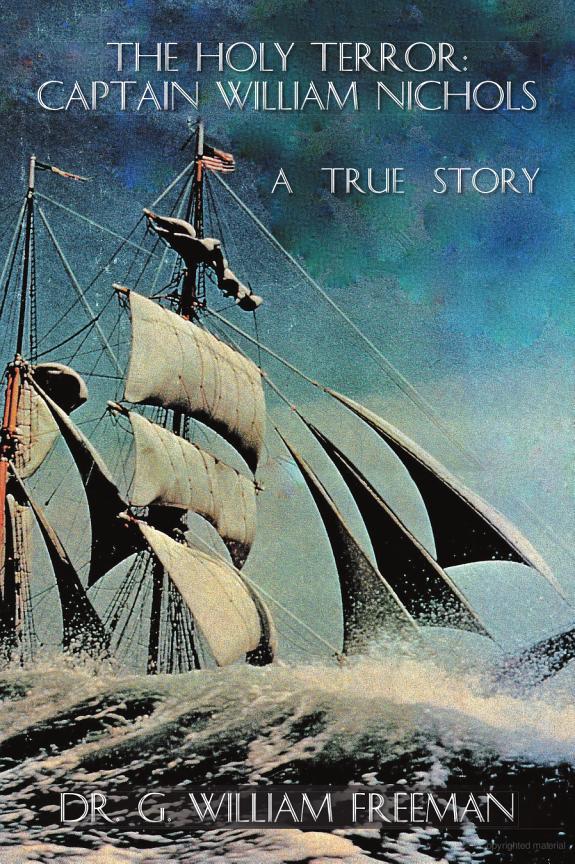
CAPTAIN WILLIAM NICHOLS Captain Nichols was a naval war hero in the War of 1812. He has been seldom mentioned in history books. He was a bold and daring privateer sea captain from Newburyport, MA, who was known as a man to be feared by the British who faced him on the sea. His story needs to be brought out of the shadows of history. "During the War, he captured 28 British Prizes, although one-half of the time he was in prison earning for himself the name of 'The Holy Terror' wherever seamen gathered". H.W. Bartlett Upon his capture in the privateer Decatur, he was held in a cage constructed for him on the deck of a British frigate and deprived of communication with others for a month. He was then held in chains on a prison-ship in Chatham Harbor, England for a year and a half. President Madison ordered two British officers held in close confinement in the United States in response to Nichols' cruel and inhumane treatment. Nichols was eventually exchanged for the two officers and returned to the United States. Following his imprisonment, he continued his naval battles against the British, completing two successful cruises on the fast-sailing privateer Harpy by the end of the war. His story rivals the tales of swashbuckling pirates that have inspired the minds of the greatest fiction writers. NEWBURYPORT, MASSACHUSETTS Newburyport is a seaport along the coast of northeastern Massachusetts with a wide harbor at the mouth of the Merrimack River. During the late eighteenth and early nineteenth centuries this Federalist town became a major seaport during its 'Golden Years' when shipbuilding and foreign trade flourished. There was great prosperity during this golden age of grandeur. It was one of the largest seaports in New England and became nationally prominent as an influential mercantile center in the United States. "Newburyport rose to fleeting greatness between1789 and 1812". L. Coffey Newburyport was home for Captain Nichols his entire life. The town was a politically-divided town, and there was strong opposition by the Federalists to the War of 1812. Towards the end of the war, Newburyport actually voted to secede from the Union, but Nichols, a Democrat, was steadfast in his determination to remain patriotic and provide valuable naval service to America. Nichols saw the devastation of his town from three successive disasters, the Embargo Act of 1807, the Great Fire in 1811, and the War of 1812. These events set a slow decline in motion of the town's importance as a commercial seaport and the golden period came to an end. Many stately Federalist-style homes built by shipowners and sea captains continue to line the streets of Newburyport as a reminder of those Golden Years. WAR OF 1812 The story of Captain William Nichols is a true narrative of an audacious and intrepid sea captain during the War of 1812. His story unfolds against the back-drop of a tapestry of events happening around the world. His adventures are interwoven into the complex sequence of events occurring in America and the world. "The War of 1812 was a strange, illogical affair; its reasoning was muddled; its execution mismanaged... it became a defining moment for our country" "War of 1812", DVD, History Channel. AN AGE OF SAILING SHIPS The early nineteenth century was a time of the sailing ships. It was a time when the grace and power of the tall ships, the whistling of the wind through the sails, and the rolling of a ship driving through the waves captured the imagination of many. This is what young boys dreamed about doing when they grew up. A WORLD GONE MAD It was a time of confusion, turmoil, and upheaval in the world, fueled by the Napoleonic Wars. America was drawn into this madness with the early French-Indian War, the revolution against the British, the war with the Barbary Pirates, and the Quasi-War with France. The continued kidnapping and impressment of sailors from neutral United States ships by the British and French sparked outrage among Americans, and led America into the War of 1812.