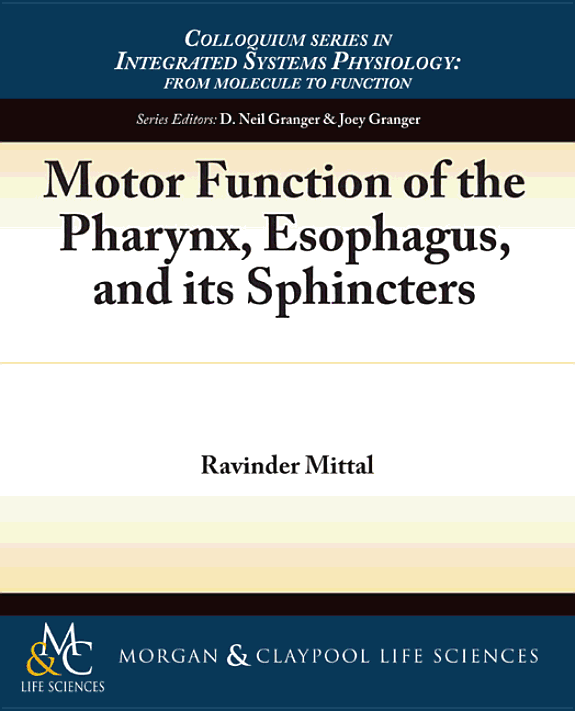
Motor Function of the Pharynx, Esophagus, and Its Sphincters

Motor Function of the Pharynx, Esophagus, and Its Sphincters

by Ravinder Mittal

75 pages· 2011· ISBN 9781615043330

Browse books you can read free on Readfeed

No club is reading this yet — be the first to start one

Start a club free
About
Deglutition or a swallow begins as a voluntary act in the oral cavity but proceeds autonomously in the pharynx and esophagus. Bilateral sequenced activation and inhibition of more than 25 pairs of muscles of mouth, pharynx, larynx, and esophagus is required during a swallow. A single swallow elicits peristalsis in the pharynx and esophagus along with relaxation of upper and lower esophageal sphincters. Multiple swallows, at closely spaced time intervals, demonstrate deglutitive inhibition; sphincters remain relaxed during the entire period, but only the last swallow elicits peristalsis. Laryngeal inlet closure or airway protection is very important during swallow. Upper part of the esophagus that includes upper esophageal sphincter is composed of skeletal muscles, middle esophagus is composed of a mixture of skeletal and smooth muscles, and lower esophagus, including lower esophageal sphincter, is composed of smooth muscles. Peristalsis progresses in seamless fashion, despite separate control mechanism, from the skeletal to smooth muscle esophagus. The esophagus's circular and longitudinal muscle layers contract synchronously during peristalsis. Sphincters maintain continuous tone; neuromuscular mechanisms for tonic closure in the upper and lower esophageal sphincters are different. Lower esophageal sphincter transient relaxation, belching mechanism, regurgitation, vomiting, and reflux are mediated via the brain stem. Table of Contents: Introduction / Central Program Generator and Brain Stem / Pharynx-Anatomy, Neural Innervation, and Motor Pattern / Upper Esophageal Sphincter / Neuromuscular Anatomy of Esophagus and Lower Esophageal Sphincter / Extrinsic Innervation: Parasympathetic and Sympathetic / Interstitial Cells of Cajal / Recording Techniques / Motor Patterns of the Esophagus-Aboral and Oral Transport / Deglutitive Inhibition and Muscle Refractoriness / Peristalsis in the Circular and Longitudinal Muscles of the Esophagus / Neural and Myogenic Mechanism of Peristalsis / Central Mechanism of Peristalsis-Cortical and Brain Stem Control / Peripheral Mechanisms of Peristalsis / Central Versus Peripheral Mechanism of Deglutitive Inhibition / Neural Control of Longitudinal Muscle Contraction / Modulation of Primary and Secondary Peristalsis / Neural Control of Lower Esophageal Sphincter and Crural Diaphragm / Lower Esophageal Sphincter / Swallow-Induced LES Relaxation / Crural Diaphragm Contribution to EGJ and Neural Control / Transient LES Relaxation and Pharmacological Inhibition / Compliance of the EGJ / References

Discuss Motor Function of the Pharynx, Esophagus, and Its Sphincters with other readers

Join or start a book club for Motor Function of the Pharynx, Esophagus, and Its Sphincters on Readfeed. Live chat, shared reading progress, and AI discussion questions — free to get started.

Frequently asked questions

How do I join a book club for Motor Function of the Pharynx, Esophagus, and Its Sphincters?

Sign up free on Readfeed, then browse public clubs or start your own club with Motor Function of the Pharynx, Esophagus, and Its Sphincters as the current read. Invite friends with a share link and discuss together with live chat and AI discussion questions.

Can I discuss Motor Function of the Pharynx, Esophagus, and Its Sphincters with other readers online?

Yes. Readfeed book clubs let you chat live, share progress, and join discussions about Motor Function of the Pharynx, Esophagus, and Its Sphincters with readers worldwide — whether your club is virtual, in-person, or hybrid.

Is Readfeed free?

Yes. Creating an account and joining book clubs is free. Sign up to find readers who love the same books and start discussing today.