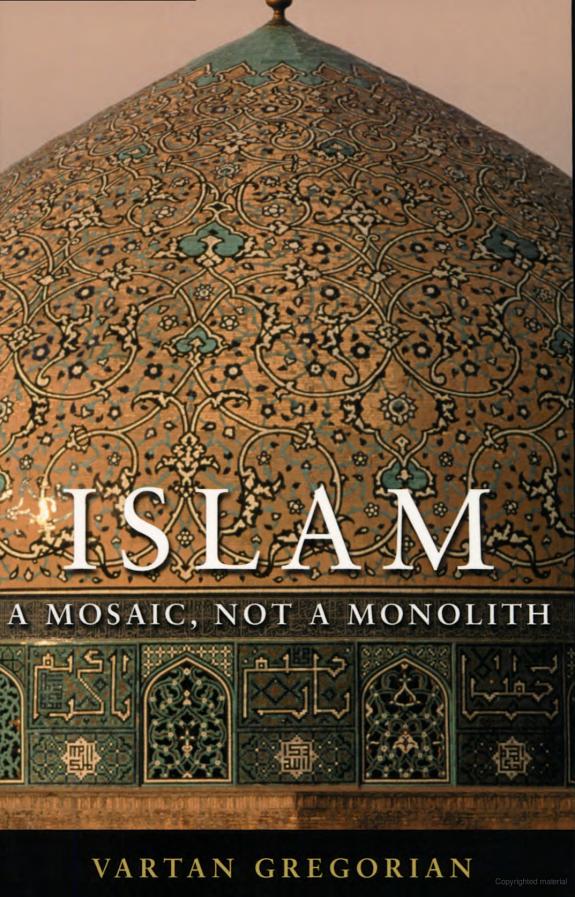
Islam
A Mosaic, Not a Monolith
by Vartan Gregorian
144 pages· 2003· ISBN 9780815796022
About
After World War II, leading western powers focused their attention on fighting the "Red Menace," Communism. Today, as terrorist activity is increasingly linked to militant Islamism, some politicians and scholars fear a "Green Menace," a Pan-Islamic totalitarian movement fueled by monolithic religious ideology.Such fears have no foundation in history, according to Vartan Gregorian. In this succinct, powerful survey of Islam, Gregorian focuses on Muslim diversity and division, portraying the faith and its people as a mosaic, not a monolith.The book begins with an accessible overview of Islam's tenets, institutions, evolution, and historical role. Gregorian traces its origins and fundamental principles, from Muhammad's call to faith nearly 1,400 years ago to the defeat of the Ottoman Empire in World War I, and the subsequent abolition of the Caliphate. He focuses particular attention on the intense struggle between modernists and traditionalists, interaction between religion and nationalism, and key developments that have caused bitter divisions among Muslim nations and states: the partitions of Palestine, the break up and Islamization of Pakistan, the 1978 revolution in Iran, and the 1979 Soviet invasion of Afghanistan.Today Islamist views range across the entire spectra of religious and political thought, and Islamism is anything but a unified movement. While religious extremists have attempted to form a confederacy of like-minded radicals in many countries, much of the Muslim population lives in relatively modern, secular states. Gregorian urges Westerners to distinguish between activist Islamist parties, which promote —sometimes violently —Islam as an ideology in a theocratic state, and Islamic parties, whose traditional members want their secular political systems to co-exist with the moral principles of their religion.Gregorian emphasizes the importance of religion in today's world and urges states,societies, and intellectuals to intervene in order to prevent Islam--as well as other religions--from becoming the political tool of various parties and states. He recommends continuing dialogues between modernist and traditionalist Muslims, as well as among the educated, secular elite and their clerical counterparts. He also urges U.S.-led efforts to engage and better understand the diversity of Muslim communities in the United States and the world. Lamenting widespread U.S. ignorance of the world's fastest-growing religion, Gregorian calls on "enlightened citizens" to promote international understanding, tolerance, and peace.
Discuss Islam with other readers
Join or start a book club for Islam on Readfeed. Live chat, shared reading progress, and AI discussion questions — free to get started.
Frequently asked questions
How do I join a book club for Islam?
Sign up free on Readfeed, then browse public clubs or start your own club with Islam as the current read. Invite friends with a share link and discuss together with live chat and AI discussion questions.
Can I discuss Islam with other readers online?
Yes. Readfeed book clubs let you chat live, share progress, and join discussions about Islam with readers worldwide — whether your club is virtual, in-person, or hybrid.
Is Readfeed free?
Yes. Creating an account and joining book clubs is free. Sign up to find readers who love the same books and start discussing today.