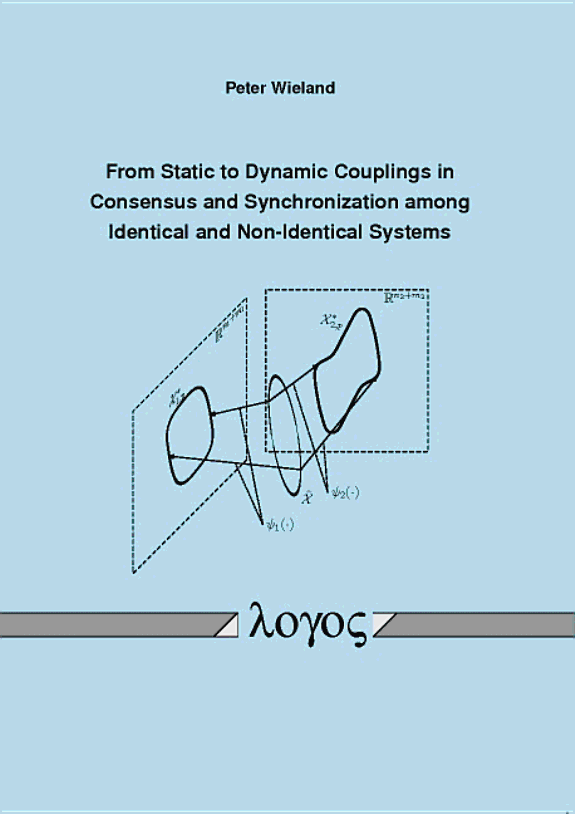
From Static to Dynamic Couplings in Consensus and Synchronization Among Identical and Non-Identical Systems

From Static to Dynamic Couplings in Consensus and Synchronization Among Identical and Non-Identical Systems

by Peter Wieland

174 pages· 2010· ISBN 9783832526382

Browse books you can read free on Readfeed

No club is reading this yet — be the first to start one

Start a club free
About
In a systems theoretic context, the terms 'consensus' and 'synchronization' both describe the property that all individual systems in a group behave asymptotically identical, i.e., output or state trajectories asymptotically converge to a common trajectory. The objective of the present thesis is an improved understanding of some of the diverse coupling mechanisms leading to consensus and synchronization. A starting point is the observation that classical consensus and synchronization results commonly deal with two distinct facets of the problem: Consensus has regularly a strong focus on the interconnections and related constraints while synchronization typically addresses questions about complex individual dynamical systems. Very few results exist that address both facets simultaneously. A thorough analysis of static couplings in consensus algorithms provides explanations for this observation by unveiling limitations inherent to this type of couplings. Novel dynamic coupling mechanisms are proposed to overcome these limitations. These methods essentially rely on an internal model principle for consensus and synchronization derived in the thesis. This principle provides necessary conditions for consensus and synchronization in groups of non-identical systems, and it establishes a link to the output regulation problem. The fresh point of view revealed by this link eventually leads to a new hierarchical mechanism for consensus and synchronization among complex non-identical systems with weak assumptions on the interconnections. Applications include synchronization of linear systems and phase synchronization of nonlinear oscillators.

Discuss From Static to Dynamic Couplings in Consensus and Synchronization Among Identical and Non-Identical Systems with other readers

Join or start a book club for From Static to Dynamic Couplings in Consensus and Synchronization Among Identical and Non-Identical Systems on Readfeed. Live chat, shared reading progress, and AI discussion questions — free to get started.

Frequently asked questions

How do I join a book club for From Static to Dynamic Couplings in Consensus and Synchronization Among Identical and Non-Identical Systems?

Sign up free on Readfeed, then browse public clubs or start your own club with From Static to Dynamic Couplings in Consensus and Synchronization Among Identical and Non-Identical Systems as the current read. Invite friends with a share link and discuss together with live chat and AI discussion questions.

Can I discuss From Static to Dynamic Couplings in Consensus and Synchronization Among Identical and Non-Identical Systems with other readers online?

Yes. Readfeed book clubs let you chat live, share progress, and join discussions about From Static to Dynamic Couplings in Consensus and Synchronization Among Identical and Non-Identical Systems with readers worldwide — whether your club is virtual, in-person, or hybrid.

Is Readfeed free?

Yes. Creating an account and joining book clubs is free. Sign up to find readers who love the same books and start discussing today.