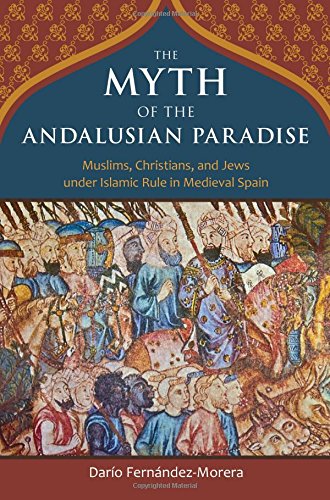
" "The Myth of the Andalusian Paradise" is essential reading. It will soon find its place on the shelves of premier academic institutions and in the syllabi of pioneering scholars. " Antonio Carreno, W. Duncan McMillan Family Professor in the Humanities, Emeritus, Brown University " I could not put this book down. "The Myth of the Andalusian Paradise" constitutes a watershed in scholarship.... Fernandez-Morera brilliantly debunks the myths that for so long have dominated Islamic historiography and conventional wisdom. We were waiting for this great breakthrough. " Raphael Israeli, Professor Emeritus of Middle Eastern, Islamic, and Chinese History, Hebrew University of Jerusalem " Fernandez-Morera examines the underside of Islamic Spain.... This is an intelligent reinterpretation of a supposed paradise of "convivencia." " Julia Pavon Benito, Professor of Medieval Spanish History, University of Navarra " Desperately, desperately needed as a counter to the mythologythat pervades academia on this subject. " PaulF. Crawford, Professor of Ancient and Medieval History, California University of Pennsylvania " A splendid book. This sober and hard-hitting reassessment demolishes the myths of religious tolerance and multiculturalism that have hopelessly romanticized the precarious coexistence and harsh realities of medieval Spain under Muslim rule.... Must-reading. " Noel Valis, Professor, Department of Spanish and Portuguese, Yale University Scholars, journalists, and even politicians uphold Muslim-ruled medieval Spain al-Andalus as a multicultural paradise, a place where Muslims, Christians, and Jews lived in harmony. There is only one problem with this widely accepted account: "it is a myth." In this groundbreaking book, Northwestern University scholar Dario Fernandez-Morera tells the "full" story of Islamic Spain. "The Myth of the Andalusian Paradise" shines light on hidden history by drawing on an abundance of primary sources that scholars have ignored, as well as archaeological evidence only recently unearthed. This supposed beacon of peaceful coexistence began, of course, with the Islamic Caliphate s conquest of Spain. Far from a land of religious tolerance, Islamic Spain was marked by religious and therefore cultural repression in all areas of life and the marginalization of Christians and other groups all this in the service of social control by autocratic rulers and a class of religious authorities. "The Myth of the Andalusian Paradise" provides a desperately needed reassessment of medieval Spain. As professors, politicians, and pundits continue to celebrate Islamic Spain for its multiculturalism and diversity, Fernandez-Morera sets the historical record straight showing that a politically useful myth is a myth nonetheless."