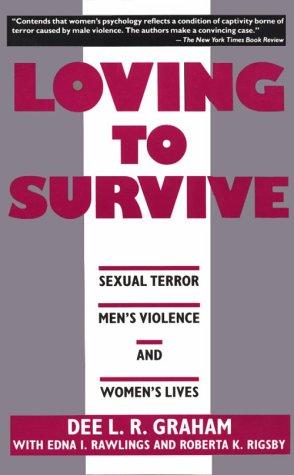
Loving to survive

Loving to survive

by Edna I. Rawlings, Dee L. Graham, Dee Graham, Roberta K. Rigsby

Part of Feminist crosscurrents

1994

Browse books you can read free on Readfeed

No club is reading this yet — be the first to start one

4 readers worldwide want to read this book

Start a club free
About
In 1973, three women and one man were held hostage in one of the largest banks in Stockholm by two ex-convicts. These two men threatened their lives, but also showed them kindness. Over the course of the long ordeal, the hostages came to identify with their captors, developing an emotional bond with them. They began to perceive the police, their prospective liberators, as their enemies, and their captors as their friends and a source of security. This seemingly bizarre reaction to captivity, in which the hostages and captors mutually bond to one another, has been documented in other cases as well, and has become widely known as Stockholm Syndrome. Dee Graham and her coauthors take this syndrome as their starting point to develop a new way of looking at male-female relationships. Loving to Survive considers men's violence against women as crucial to understanding women's current psychology. Men's violence creates ever present, and therefore often unrecognized, terror in women. This terror is often experienced as a fear - for any woman - of rape by any man or as a fear of making a man - any man - angry. They propose that women's current psychology is actually a psychology of women under conditions of captivity - that is, under conditions of terror caused by male violence against women. Therefore, women's responses to men, and to male violence, resemble hostages' responses to captors. . Loving to Survive proposes that, like hostages who work to placate their captors lest they kill them, women work to please men, and from this springs women's femininity. Femininity describes a set of behaviors that please men because they communicate a woman's acceptance of her subordinate status. Thus, feminine behaviors are, in essence, survival strategies. Like hostages who bond to their captors, women bond to men in an effort to survive. This is a book that will forever change the way we look at male-female relationships and women's lives.

Discuss Loving to survive with other readers

Join or start a book club for Loving to survive on Readfeed. Live chat, shared reading progress, and AI discussion questions — free to get started.

Frequently asked questions

How do I join a book club for Loving to survive?

Sign up free on Readfeed, then browse public clubs or start your own club with Loving to survive as the current read. Invite friends with a share link and discuss together with live chat and AI discussion questions.

Can I discuss Loving to survive with other readers online?

Yes. Readfeed book clubs let you chat live, share progress, and join discussions about Loving to survive with readers worldwide — whether your club is virtual, in-person, or hybrid.

Is Readfeed free?

Yes. Creating an account and joining book clubs is free. Sign up to find readers who love the same books and start discussing today.