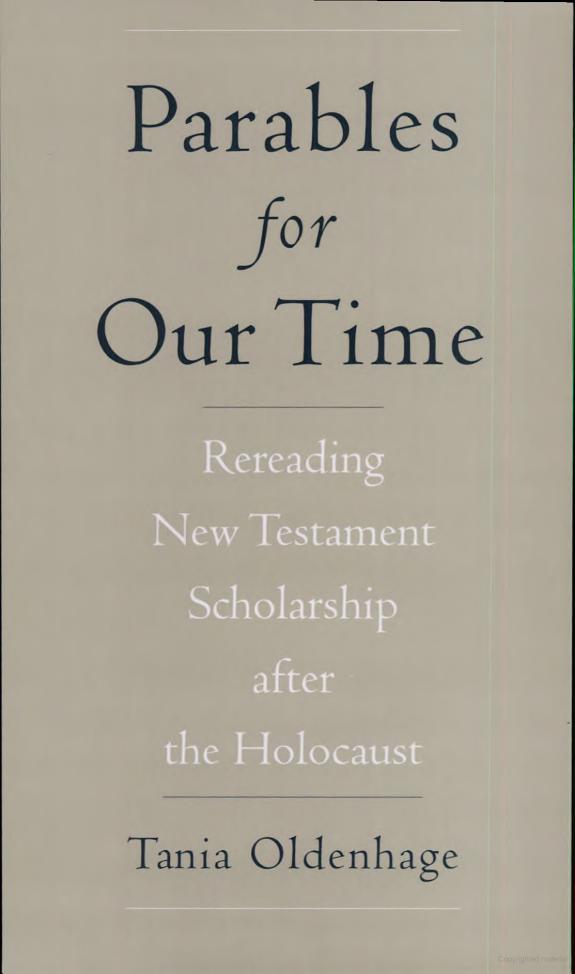
Parables for Our Time

Parables for Our Time

Rereading New Testament Scholarship after the Holocaust

by Tania Oldenhage

189 pages· 2010· ISBN 9780198034278

Browse books you can read free on Readfeed

No club is reading this yet — be the first to start one

Start a club free
About
Over the centuries, New Testament texts have often been read in ways that reflect and encourage anti-Semitism. For example, the parable of the "wicked husbandmen," who kill the son of their landlord in order to seize the land, has been used to blame the Jews for the death of Christ. Since the Holocaust, Christian scholars have increasingly recognized and rejected this inheritance. In Parables for Our Time Tania Oldenhage seeks to fashion a biblical hermeneutics that consciously works with memories of the Holocaust. New Testament scholars have not directly confronted the horror of Nazi crimes, Oldenhage argues, but their work has nonetheless been deeply affected by the events of the Holocaust. By placing twentieth-century biblical scholarship within its specific historical and cultural contexts, she is able to trace the process by which the Holocaust gradually moved into the collective consciousness of New Testament scholars, both in Germany and in the United States. Her focus is on the scholarly interpretation of the parables of Jesus. She sets the stage with the work of Wolfgang Harnisch who exemplifies the problems surrounding Holocaust remembrance in the Germany of the 1980s and 1990s. She then turns to Joachim Jeremias's eminent work on the parables, first published in 1947. Jeremias's anti-Jewish rhetoric, she argues, should be understood not only as a perpetuation of an age-old interpretive pattern, but as representative of German difficulties in responding to the Holocaust immediately after the war. Oldenhage goes on to explore the way in which Jeremias's approach was challenged by biblical scholars in the U.S. during the 1970s. In particular, she examines the turn to literature and literary theory exemplified in the works of John Dominic Crossan and Paul Ricoeur. Nazi atrocities became part of the cultural reservoir from which Crossan and Ricoeur drew, she shows, although they never engaged with the historical facts of the Holocaust. In conclusion, Oldenhage offers her own reading of the parable of the wicked husbandmen, demonstrating how the turn from historical to literary criticism opens up the text to interpretation in light of the Holocaust. If the parables are to be meaningful in our time, she contends, we must take account of the troubling resonances between these ancient Christian stories and the atrocities of Auschwitz.

Discuss Parables for Our Time with other readers

Join or start a book club for Parables for Our Time on Readfeed. Live chat, shared reading progress, and AI discussion questions — free to get started.

Frequently asked questions

How do I join a book club for Parables for Our Time?

Sign up free on Readfeed, then browse public clubs or start your own club with Parables for Our Time as the current read. Invite friends with a share link and discuss together with live chat and AI discussion questions.

Can I discuss Parables for Our Time with other readers online?

Yes. Readfeed book clubs let you chat live, share progress, and join discussions about Parables for Our Time with readers worldwide — whether your club is virtual, in-person, or hybrid.

Is Readfeed free?

Yes. Creating an account and joining book clubs is free. Sign up to find readers who love the same books and start discussing today.