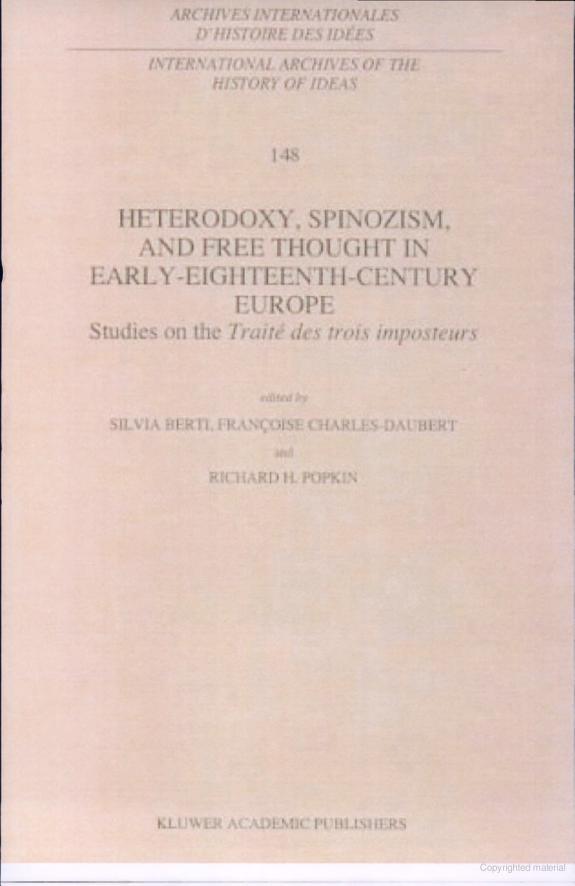
Heterodoxy, Spinozism, and Free Thought in Early-Eighteenth-Century Europe

Heterodoxy, Spinozism, and Free Thought in Early-Eighteenth-Century Europe

Studies on the Traité des Trois Imposteurs

by R.H. Popkin, Silvia Berti, Françoise Charles-Daubert

532 pages· 1996· ISBN 9780792341925

Browse books you can read free on Readfeed

About
'the oldest biography of Spinoza', La Vie de Mr. Spinosa, which in the manuscript copies is often followed by L'Esprit de M. Spinosa. Margaret Jacob, in her Radical Enlightenment, contended that the Traite was written by a radical group of Freemasons in The Hague in the early eighteenth century. Silvia Berti has offered evidence it was written by Jan Vroesen. Various discussions in the early eighteenth century consider many possi ble authors from the Renaissance onwards to whom the work might be attributed. The Trois imposteurs has attracted quite a bit of recent attention as one of the most significant irreligious clandestine writings available in the Enlightenment, which is most important for understanding the develop ment of religious scepticism, radical deism, and even atheism in the seventeenth and eighteenth centuries. Scholars for the last couple of decades have been trying to assess when the work was actually written or compiled and by whom. In view of the widespread distribution of manu scripts of the work all over Europe, they have also been seeking to find out who was influenced by the work, and what it represented for its time. Hitherto unknown manuscripts are being turned up in public and private libraries all over Europe and the United States.

Discuss Heterodoxy, Spinozism, and Free Thought in Early-Eighteenth-Century Europe with other readers

Join or start a book club for Heterodoxy, Spinozism, and Free Thought in Early-Eighteenth-Century Europe on Readfeed. Live chat, shared reading progress, and AI discussion questions — free to get started.

Frequently asked questions

How do I join a book club for Heterodoxy, Spinozism, and Free Thought in Early-Eighteenth-Century Europe?

Sign up free on Readfeed, then browse public clubs or start your own club with Heterodoxy, Spinozism, and Free Thought in Early-Eighteenth-Century Europe as the current read. Invite friends with a share link and discuss together with live chat and AI discussion questions.

Can I discuss Heterodoxy, Spinozism, and Free Thought in Early-Eighteenth-Century Europe with other readers online?

Yes. Readfeed book clubs let you chat live, share progress, and join discussions about Heterodoxy, Spinozism, and Free Thought in Early-Eighteenth-Century Europe with readers worldwide — whether your club is virtual, in-person, or hybrid.

Is Readfeed free?

Yes. Creating an account and joining book clubs is free. Sign up to find readers who love the same books and start discussing today.