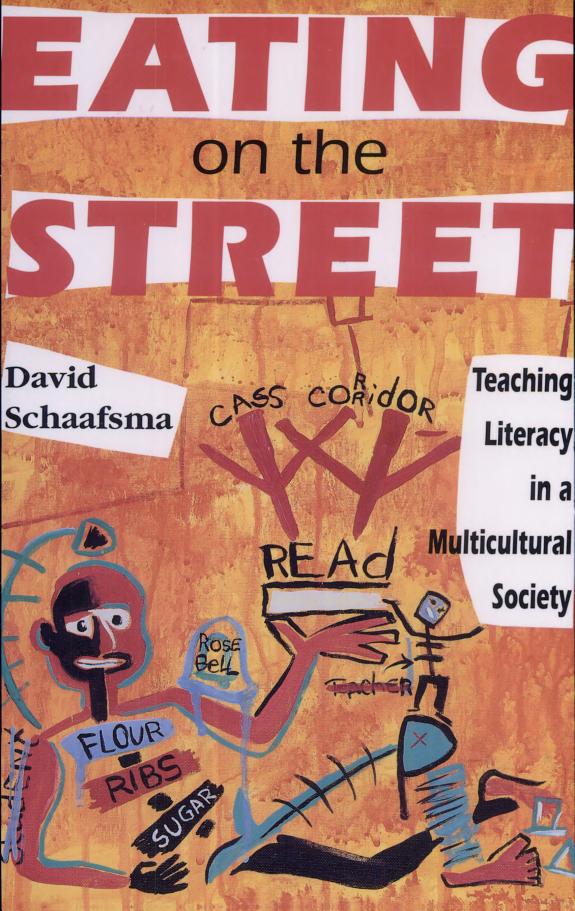
During a field trip in Detroit on a summer day in 1989, a group of African American fifth-, sixth-, and seventh-graders talked, laughed, and ate snacks as they walked. Later, in the teacher’s lounge, Jeanetta, an African American teacher chided the teachers, black and white, for not correcting poor black students for “eating on the street,” something she saw as stereotypical behavior that stigmatized students. These thirty children from Detroit’s Cass Corridor neighborhood were enrolled in the Dewey Center Community Writing Project. Taught by seven teachers from the University of Michigan and the Detroit public schools, the program guided students to explore, to interpret, and to write about their community. According to David Schaafsma, one of the teachers, the “eating on the street” controversy is emblematic of how cultural values and cultural differences affect education in American schools today. From this incident Schaafsma has written a powerful and compelling book about the struggle of teaching literacy in a racially divided society and the importance of story and storytelling in the educational process. At the core of this book is the idea of storytelling as an interactive experience for both the teller and listener. Schaafsma begins by telling his own version of the “eating on the street” conflict. He describes the history of the writing program and offers rich samples of the students’ writing about their lives in a troubled neighborhood. After the summer program, Schaafsma interviewed all the teachers about their own version of events, their personal histories, and their work as educators. Eating on the Street presents all of these layered stories - by Schaafsma, his collegues, and the students - to illustrate how talking across multiple perspectives can enrich the learning process and the community-building process outside the classroom as well. These accounts have strong implications for multicultural education today. They will interest teachers, educational experts, administrators, and researchers. Uniting theory and practice, Eating on the Street is on the cutting edge of pioneering work in educational research.