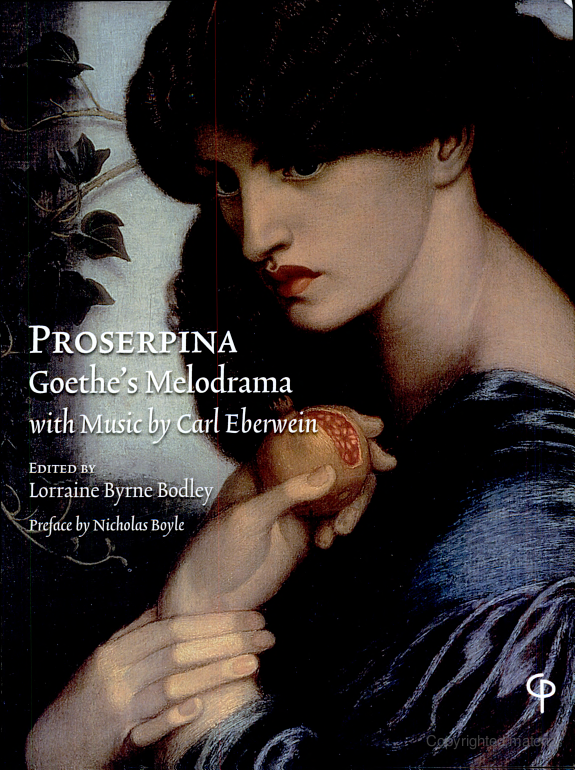
Proserpina

Proserpina

by Johann Wolfgang von Goethe, Nicholas Boyle, Carl Eberwein, Lorraine Byrne Bodley

182 pages· 2007· ISBN 9781904505273

Browse books you can read free on Readfeed

No club is reading this yet — be the first to start one

Start a club free
About
In his early twenties Goethe wrote Proserpina for the Weimar court singer Corona Schroter to perform. His interest in presenting Weimar's first professional singer-in-residence in a favourable light was not the only reason why this monologue with music (now lost) by Seckendorff is important. Goethe's memories of his sister Cornelia, who had recently died in childbirth, were in fact the real catalyst: through this work Goethe could level accusations against his parents about Cornelia's marriage, of which he had not approved. Goethe used the melodramatic form to transform private and cultural issues for women of the time into public discourses and so to manipulate public opinion. His work reveals an astute understanding of musical melodrama and the important impact it had on the cultural dynamics of the late eighteenth and early nineteenth centuries. Whatever the source of inspiration, it is clear that Goethe was very preoccupied with Proserpina. When he returned to this melodrama forty years later he collaborated closely with Carl Eberwein, the court, theatre, and church music director, who composed a new setting which accords with Goethe's clear understanding of musical declamation in 19th century melodrama. In the intensive collaboration which took place while the production was being prepared in January 1815, Goethe was already anticipating the idea of a Gesamtkunstwerk. He paid close attention to every aspect of the production, especially to its music and its staging. When discussing contemporary settings of the poet's works, scholars often lapse into regret that Goethe did not have someone of comparable rank at his side for musical collaborations. Yet Eberwein's willingness to go along with Goethe's wishes was an advantage here: the selfless striving of the young composer to satisfy the poet's intentions is everywhere apparent in the score and it is the nearest thing we have to a 'composition by Goethe'. Despite critics' positive reception of the first performance on 4 February 1815, the work has never been published before. Musically and dramatically this unknown melodrama is a superb work for solo voice, choir, and orchestra, and deserves to be brought before the public today.

Discuss Proserpina with other readers

Join or start a book club for Proserpina on Readfeed. Live chat, shared reading progress, and AI discussion questions — free to get started.

Frequently asked questions

How do I join a book club for Proserpina?

Sign up free on Readfeed, then browse public clubs or start your own club with Proserpina as the current read. Invite friends with a share link and discuss together with live chat and AI discussion questions.

Can I discuss Proserpina with other readers online?

Yes. Readfeed book clubs let you chat live, share progress, and join discussions about Proserpina with readers worldwide — whether your club is virtual, in-person, or hybrid.

Is Readfeed free?

Yes. Creating an account and joining book clubs is free. Sign up to find readers who love the same books and start discussing today.