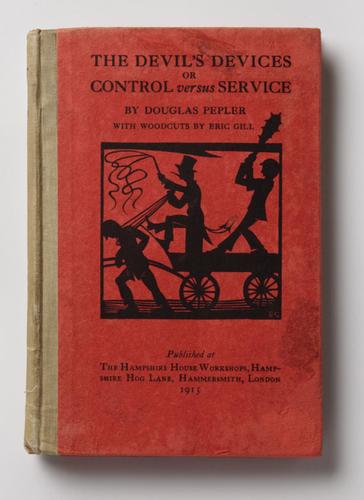
The Devil's devices, or, Control versus service

The Devil's devices, or, Control versus service

by H. D. C. Pepler

1915

Browse books you can read free on Readfeed

No club is reading this yet — be the first to start one

Start a club free
About
"The Devil's Devices, Control vs Service", is a collectible book published in 1915, and best (though still rarely) known for its Eric Gill woodcut engravings. While it might be in line with some Christian thinking it would be more accurate to state that the book leverages an assumed knowledge of Christ, the Devil and other aspects of Christianity than to categorize it as what is most commonly understood as "Christian". It does deal with the life and death of Jesus in a way that appreciates his humanity, commitment and sacrifice while its use of the Devil is to label the beguiling broad road to helpless-cog-in-a-factory behavior. It should be better known and distributed in paperback form for its respectful treatment of work and craftsmanship, its disdain for servitude and its challenge to the questionable benefits of higher productivity of lesser quality goods. In The Devil's Devices, Hilary Pepler holds individuals responsible for the current state of affairs and, rather than criticize those who identify with their work, offers an alternate path (with significant historical precedent) where work and servitude aren't the same thing, making work an honorable, important, perhaps even a central part of one's existence. Further, he offers no out for the supposedly "powerless" individual nor does he plot revolution to seize control. Using Jesus as an example he suggests that good human behavior may bring fulfillment but necessarily end on the cross. And he doesn't offer some future, heavenly reward--in fact he suggests that such motivation is more likely a devilish device. Reminding us of something our parents (or at least great-grandparents) taught and something we all recognize, to a more or less vague extent, to be true, Pepler offers challenge and hard work as essential, not sacrificial. He maintains the individuals accountability for his state of affairs, since the individual retains much in the way of choice over his own actions and approach to life and work--if he will accept genuine rewards in exchange for what some might call "sacrifices". Thanks are owed to Microsoft for funding the digitization of this book (every page includes a note that it was "digitized by Microsoft") and certainly to Cornell University for digitizing its copy of this rare book and making it available online.

Discuss The Devil's devices, or, Control versus service with other readers

Join or start a book club for The Devil's devices, or, Control versus service on Readfeed. Live chat, shared reading progress, and AI discussion questions — free to get started.

Frequently asked questions

How do I join a book club for The Devil's devices, or, Control versus service?

Sign up free on Readfeed, then browse public clubs or start your own club with The Devil's devices, or, Control versus service as the current read. Invite friends with a share link and discuss together with live chat and AI discussion questions.

Can I discuss The Devil's devices, or, Control versus service with other readers online?

Yes. Readfeed book clubs let you chat live, share progress, and join discussions about The Devil's devices, or, Control versus service with readers worldwide — whether your club is virtual, in-person, or hybrid.

Is Readfeed free?

Yes. Creating an account and joining book clubs is free. Sign up to find readers who love the same books and start discussing today.