Safety in Numbers and Power in Determining Strategy Evolution in the Game of Chicken

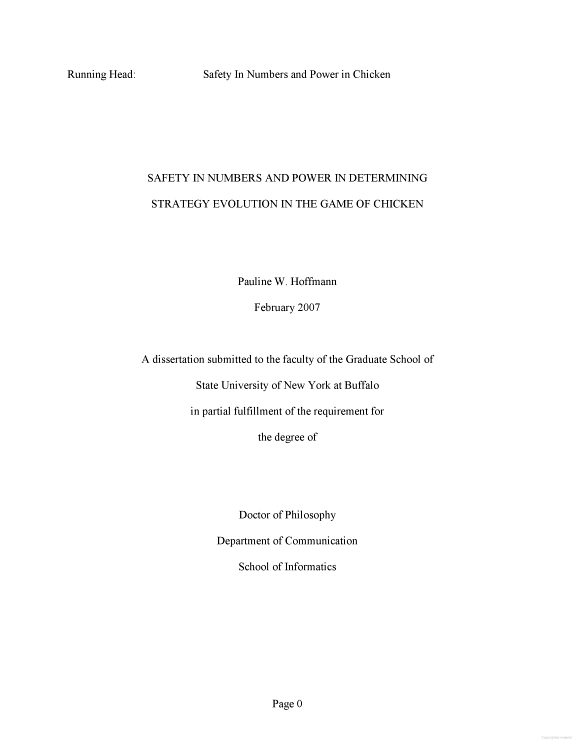
Safety in Numbers and Power in Determining Strategy Evolution in the Game of Chicken

247 pages· 2007· ISBN 9780542998362
About
Game theory has been used in computer simulations to model bargaining and conflict behavior. The game of Chicken, in particular, recognizes the need for a cooperative collusive strategy for the success of the competitors. Cellular automata are network matrices often used in simulations. Each node of the network is occupied by an individual strategy playing another strategy at an adjacent node. Safety In Numbers (SIN) examines the benefit of individuals with common strategies working together against an enemy or opponent also clustered in a SIN-like manner. Power references the effect of greater threat potential or strength in bargaining and conflict situations. This dissertation uses SIN and power in two different simulations to determine the success of strategy groups Good and Evil playing the game of Chicken in a cellular automata regularized spatial grid (RSG) matrix. This RSG matrix allows 400 competitors to compete simultaneously with eight neighbors with the competitor adopting the strategy of its most successful neighbor or maintaining its own should it be most successful. The Chicken matrix is used as the utility and strategies begin by being clumped together (SIN) in varying quantities. Simulation 1 examines the effect of SIN on its own using a common Chicken payoff matrix. Good strategies prevailed in relatively low numbers (starting at 10). No matter the victor, strategy groups tended to remain clustered as would be expected with SIN. Simulation 2 altered the Chicken payoff matrix asymmetrically such that more power was allotted to a strategy group in varying increments, in this case Evil strategies were given more power. Evil strategies did overcome Good strategies at a power factor of 0.7 but SIN clustering of simulation 1 did not occur with greater power. In fact, much individual competition was seen. Additionally, in both simulations, in-group competition was expected between like strategies. In both cases, one Good strategy dominated---TESTER, while two Evil strategies competed---MODIFIED GRUDGE and GRUDGE.

Discuss Safety in Numbers and Power in Determining Strategy Evolution in the Game of Chicken with other readers

Join or start a book club for Safety in Numbers and Power in Determining Strategy Evolution in the Game of Chicken on Readfeed. Live chat, shared reading progress, and AI discussion questions — free to get started.

Frequently asked questions

How do I join a book club for Safety in Numbers and Power in Determining Strategy Evolution in the Game of Chicken?

Sign up free on Readfeed, then browse public clubs or start your own club with Safety in Numbers and Power in Determining Strategy Evolution in the Game of Chicken as the current read. Invite friends with a share link and discuss together with live chat and AI discussion questions.

Can I discuss Safety in Numbers and Power in Determining Strategy Evolution in the Game of Chicken with other readers online?

Yes. Readfeed book clubs let you chat live, share progress, and join discussions about Safety in Numbers and Power in Determining Strategy Evolution in the Game of Chicken with readers worldwide — whether your club is virtual, in-person, or hybrid.

Is Readfeed free?

Yes. Creating an account and joining book clubs is free. Sign up to find readers who love the same books and start discussing today.