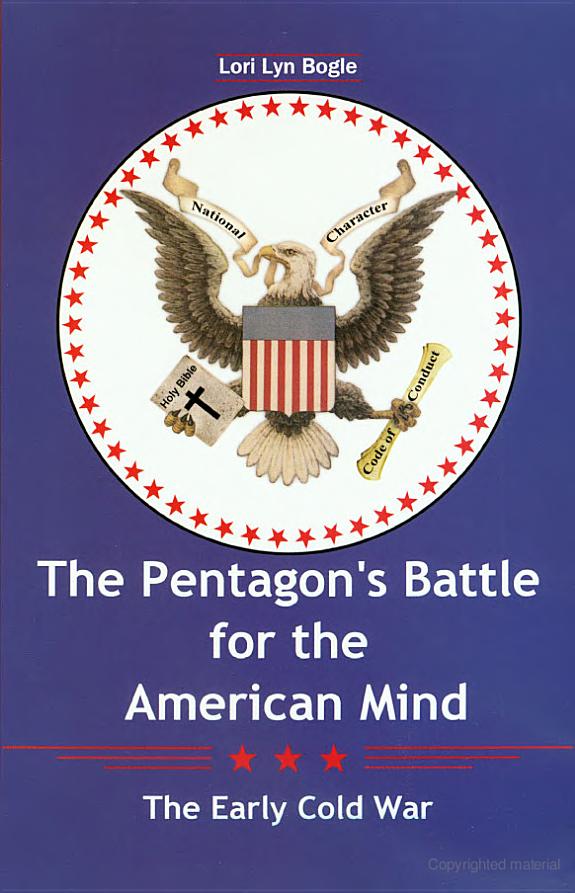
The Pentagon’s Battle for the American Mind

The Pentagon’s Battle for the American Mind

The Early Cold War

by Lori L. Bogle

220 pages· 2004· ISBN 9781585443789

Browse books you can read free on Readfeed

No club is reading this yet — be the first to start one

Start a club free
About
The U.S. military has historically believed itself to be the institution best suited to develop the character, spiritual values, and patriotism of American youth. In Strategy for Survival, Lori Bogle investigates how the armed forces assigned itself the role of guardian and interpreter of national values and why it sought to create “ideologically sound Americans capable of defeating communism and assuring the victory of democracy at home and abroad.” Bogle shows that a tendency by some in the armed forces to diffuse their view of America’s civil religion among the general population predated tension with the Soviet Union. Bogle traces this trend from the Progressive Era though the early Cold War, when the Truman and Eisenhower administrations took seriously the battle of ideologies of that era and formulated plans that promised not only to meet the armed forces’ manpower needs but also to prepare the American public morally and spiritually for confrontation with the evils of communism. Both Truman’s plan for Universal Military Training and Eisenhower’s psychological warfare programs promoted an evangelical democracy and sought to inculcate a secular civil-military religion in the general public. During the early 1960s, joint military-civilian anticommunist conferences, organized by the authority of the Department of Defense, were exploited by ultra-conservative civilians advancing their own political and religious agendas. Bogle’s analysis suggests that cooperation among evangelicals, the military, and government was considered both necessary and normal. The Boy Scouts pushed a narrow vision of American democracy, and Joe McCarthy’s chauvinism was less an aberration than a particularly noxious manifestation of a widespread attitude. To combat communism, American society and its armed forces embraced brainwashing—narrow moral education that attacked everyone and everything not consonant with their view of the world and how it ought to be ordered. Exposure of this alliance ultimately dissolved it. However, the cult of toughness and the blinkered view of reality that characterized the armed forces and American society during the Cold War are still valued by many, and are thus still worthy of consideration.

Discuss The Pentagon’s Battle for the American Mind with other readers

Join or start a book club for The Pentagon’s Battle for the American Mind on Readfeed. Live chat, shared reading progress, and AI discussion questions — free to get started.

Frequently asked questions

How do I join a book club for The Pentagon’s Battle for the American Mind?

Sign up free on Readfeed, then browse public clubs or start your own club with The Pentagon’s Battle for the American Mind as the current read. Invite friends with a share link and discuss together with live chat and AI discussion questions.

Can I discuss The Pentagon’s Battle for the American Mind with other readers online?

Yes. Readfeed book clubs let you chat live, share progress, and join discussions about The Pentagon’s Battle for the American Mind with readers worldwide — whether your club is virtual, in-person, or hybrid.

Is Readfeed free?

Yes. Creating an account and joining book clubs is free. Sign up to find readers who love the same books and start discussing today.