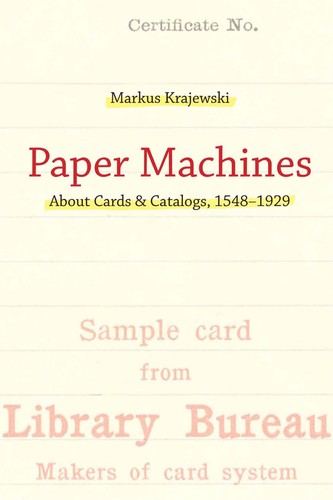
Paper machines

Paper machines

by Peter Krapp, Markus Krajewski

Part of History and foundations of information science

Browse books you can read free on Readfeed

No club is reading this yet — be the first to start one

3 readers worldwide want to read this book

Start a club free
About
"Today on almost every desk in every office sits a computer. Eighty years ago, desktops were equipped with a nonelectronic data processing machine: a card file. In Paper Machines, Markus Krajewski traces the evolution of this proto-computer of rearrangeable parts (file cards) that became ubiquitous in offices between the world wars. The story begins with Konrad Gessner, a sixteenth-century Swiss polymath who described a new method of processing data: to cut up a sheet of handwritten notes into slips of paper, with one fact or topic per slip, and arrange as desired. In the late eighteenth century, the card catalog became the librarian's answer to the threat of information overload. Then, at the turn of the twentieth century, business adopted the technology of the card catalog as a bookkeeping tool. Krajewski explores this conceptual development and casts the card file as a "universal paper machine" that accomplishes the basic operations of Turing's universal discrete machine: storing, processing, and transferring data. In telling his story, Krajewski takes the reader on a number of illuminating detours, telling us, for example, that the card catalog and the numbered street address emerged at the same time in the same city (Vienna), and that Harvard University's home-grown cataloging system grew out of a librarian's laziness; and that Melvil Dewey (originator of the Dewey Decimal System) helped bring about the technology transfer of card files to business."--Publisher's website.

Discuss Paper machines with other readers

Join or start a book club for Paper machines on Readfeed. Live chat, shared reading progress, and AI discussion questions — free to get started.

Frequently asked questions

How do I join a book club for Paper machines?

Sign up free on Readfeed, then browse public clubs or start your own club with Paper machines as the current read. Invite friends with a share link and discuss together with live chat and AI discussion questions.

Can I discuss Paper machines with other readers online?

Yes. Readfeed book clubs let you chat live, share progress, and join discussions about Paper machines with readers worldwide — whether your club is virtual, in-person, or hybrid.

Is Readfeed free?

Yes. Creating an account and joining book clubs is free. Sign up to find readers who love the same books and start discussing today.