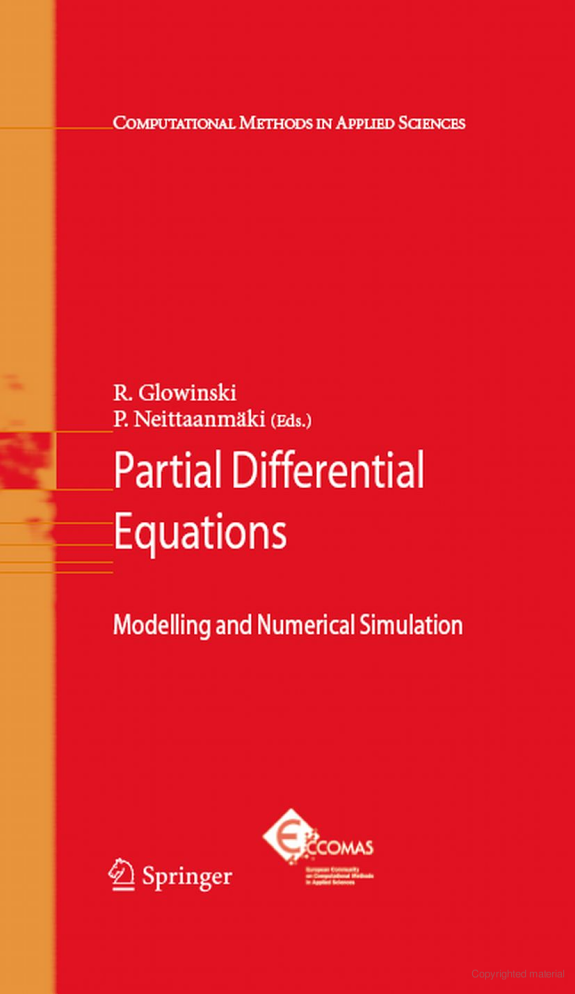
Partial Differential Equations

Partial Differential Equations

Modelling and Numerical Simulation

by Pekka Neittaanmäki, Roland Glowinski

292 pages· 2008· ISBN 9781402087585

Browse books you can read free on Readfeed

No club is reading this yet — be the first to start one

Start a club free
About
For more than 250 years partial di?erential equations have been clearly the most important tool available to mankind in order to understand a large variety of phenomena, natural at ?rst and then those originating from - man activity and technological development. Mechanics, physics and their engineering applications were the ?rst to bene?t from the impact of partial di?erential equations on modeling and design, but a little less than a century ago the Schr ̈ odinger equation was the key opening the door to the application of partial di?erential equations to quantum chemistry, for small atomic and molecular systems at ?rst, but then for systems of fast growing complexity. The place of partial di?erential equations in mathematics is a very particular one: initially, the partial di?erential equations modeling natural phenomena were derived by combining calculus with physical reasoning in order to - press conservation laws and principles in partial di?erential equation form, leading to the wave equation, the heat equation, the equations of elasticity, the Euler and Navier–Stokes equations for ?uids, the Maxwell equations of electro-magnetics, etc. It is in order to solve ‘constructively’ the heat equation that Fourier developed the series bearing his name in the early 19th century; Fourier series (and later integrals) have played (and still play) a fundamental roleinbothpureandappliedmathematics,includingmanyareasquiteremote from partial di?erential equations. On the other hand, several areas of mathematics such as di?erential ge- etry have bene?ted from their interactions with partial di?erential equations.

Discuss Partial Differential Equations with other readers

Join or start a book club for Partial Differential Equations on Readfeed. Live chat, shared reading progress, and AI discussion questions — free to get started.

Frequently asked questions

How do I join a book club for Partial Differential Equations?

Sign up free on Readfeed, then browse public clubs or start your own club with Partial Differential Equations as the current read. Invite friends with a share link and discuss together with live chat and AI discussion questions.

Can I discuss Partial Differential Equations with other readers online?

Yes. Readfeed book clubs let you chat live, share progress, and join discussions about Partial Differential Equations with readers worldwide — whether your club is virtual, in-person, or hybrid.

Is Readfeed free?

Yes. Creating an account and joining book clubs is free. Sign up to find readers who love the same books and start discussing today.