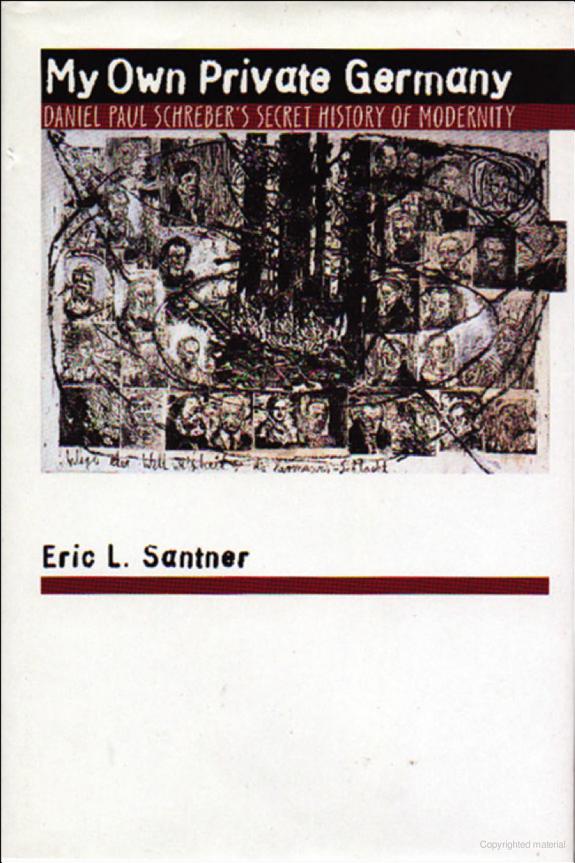
My Own Private Germany

My Own Private Germany

Daniel Paul Schreber's Secret History of Modernity

by Eric L. Santner

214 pages· 1997· ISBN 9781400821891

Browse books you can read free on Readfeed

No club is reading this yet — be the first to start one

Start a club free
About
In November 1893, Daniel Paul Schreber, recently named presiding judge of the Saxon Supreme Court, was on the verge of a psychotic breakdown and entered a Leipzig psychiatric clinic. He would spend the rest of the nineteenth century in mental institutions. Once released, he published his Memoirs of My Nervous Illness (1903), a harrowing account of real and delusional persecution, political intrigue, and states of sexual ecstasy as God's private concubine. Freud's famous case study of Schreber elevated the Memoirs into the most important psychiatric textbook of paranoia. In light of Eric Santner's analysis, Schreber's text becomes legible as a sort of "nerve bible" of fin-de-siècle preoccupations and obsessions, an archive of the very phantasms that would, after the traumas of war, revolution, and the end of empire, coalesce into the core elements of National Socialist ideology. The crucial theoretical notion that allows Santner to pass from the "private" domain of psychotic disturbances to the "public" domain of the ideological and political genesis of Nazism is the "crisis of investiture." Schreber's breakdown was precipitated by a malfunction in the rites and procedures through which an individual is endowed with a new social status: his condition became acute just as he was named to a position of ultimate symbolic authority. The Memoirs suggest that we cross the threshold of modernity into a pervasive atmosphere of crisis and uncertainty when acts of symbolic investiture no longer usefully transform the subject's self understanding. At such a juncture, the performative force of these rites of institution may assume the shape of a demonic persecutor, some "other" who threatens our borders and our treasures. Challenging other political readings of Schreber, Santner denies that Schreber's delusional system--his own private Germany--actually prefigured the totalitarian solution to this defining structural crisis of modernity. Instead, Santner shows how this tragic figure succeeded in avoiding the totalitarian temptation by way of his own series of perverse identifications, above all with women and Jews.

Discuss My Own Private Germany with other readers

Join or start a book club for My Own Private Germany on Readfeed. Live chat, shared reading progress, and AI discussion questions — free to get started.

Frequently asked questions

How do I join a book club for My Own Private Germany?

Sign up free on Readfeed, then browse public clubs or start your own club with My Own Private Germany as the current read. Invite friends with a share link and discuss together with live chat and AI discussion questions.

Can I discuss My Own Private Germany with other readers online?

Yes. Readfeed book clubs let you chat live, share progress, and join discussions about My Own Private Germany with readers worldwide — whether your club is virtual, in-person, or hybrid.

Is Readfeed free?

Yes. Creating an account and joining book clubs is free. Sign up to find readers who love the same books and start discussing today.