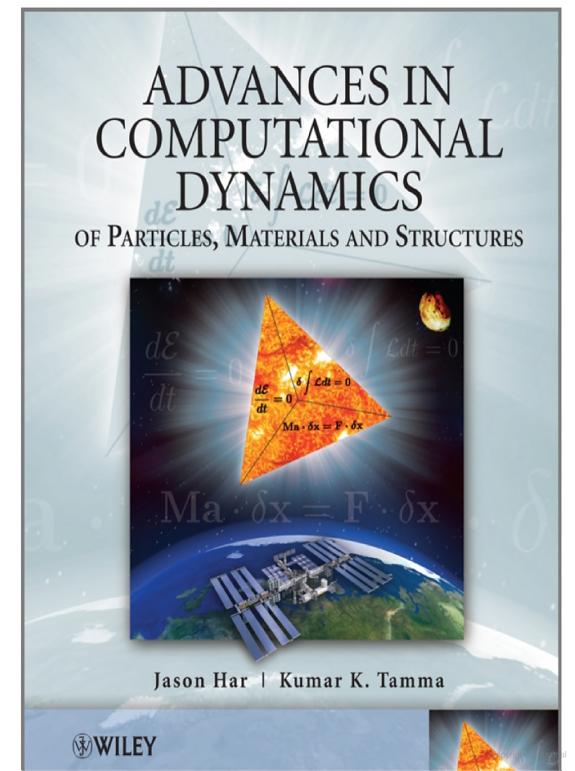
Advances in Computational Dynamics of Particles, Materials and Structures

Advances in Computational Dynamics of Particles, Materials and Structures

by Jason Har, Kumar Tamma

704 pages· 2012· ISBN 9781119966920

Browse books you can read free on Readfeed

No club is reading this yet — be the first to start one

Start a club free
About
Computational methods for the modeling and simulation of the dynamic response and behavior of particles, materials and structural systems have had a profound influence on science, engineering and technology. Complex science and engineering applications dealing with complicated structural geometries and materials that would be very difficult to treat using analytical methods have been successfully simulated using computational tools. With the incorporation of quantum, molecular and biological mechanics into new models, these methods are poised to play an even bigger role in the future. Advances in Computational Dynamics of Particles, Materials and Structures not only presents emerging trends and cutting edge state-of-the-art tools in a contemporary setting, but also provides a unique blend of classical and new and innovative theoretical and computational aspects covering both particle dynamics, and flexible continuum structural dynamics applications. It provides a unified viewpoint and encompasses the classical Newtonian, Lagrangian, and Hamiltonian mechanics frameworks as well as new and alternative contemporary approaches and their equivalences in [start italics]vector and scalar formalisms[end italics] to address the various problems in engineering sciences and physics. Highlights and key features Provides practical applications, from a unified perspective, to both particle and continuum mechanics of flexible structures and materials Presents new and traditional developments, as well as alternate perspectives, for space and time discretization Describes a unified viewpoint under the umbrella of Algorithms by Design for the class of linear multi-step methods Includes fundamentals underlying the theoretical aspects and numerical developments, illustrative applications and practice exercises The completeness and breadth and depth of coverage makes Advances in Computational Dynamics of Particles, Materials and Structures a valuable textbook and reference for graduate students, researchers and engineers/scientists working in the field of computational mechanics; and in the general areas of computational sciences and engineering.

Discuss Advances in Computational Dynamics of Particles, Materials and Structures with other readers

Join or start a book club for Advances in Computational Dynamics of Particles, Materials and Structures on Readfeed. Live chat, shared reading progress, and AI discussion questions — free to get started.

Frequently asked questions

How do I join a book club for Advances in Computational Dynamics of Particles, Materials and Structures?

Sign up free on Readfeed, then browse public clubs or start your own club with Advances in Computational Dynamics of Particles, Materials and Structures as the current read. Invite friends with a share link and discuss together with live chat and AI discussion questions.

Can I discuss Advances in Computational Dynamics of Particles, Materials and Structures with other readers online?

Yes. Readfeed book clubs let you chat live, share progress, and join discussions about Advances in Computational Dynamics of Particles, Materials and Structures with readers worldwide — whether your club is virtual, in-person, or hybrid.

Is Readfeed free?

Yes. Creating an account and joining book clubs is free. Sign up to find readers who love the same books and start discussing today.