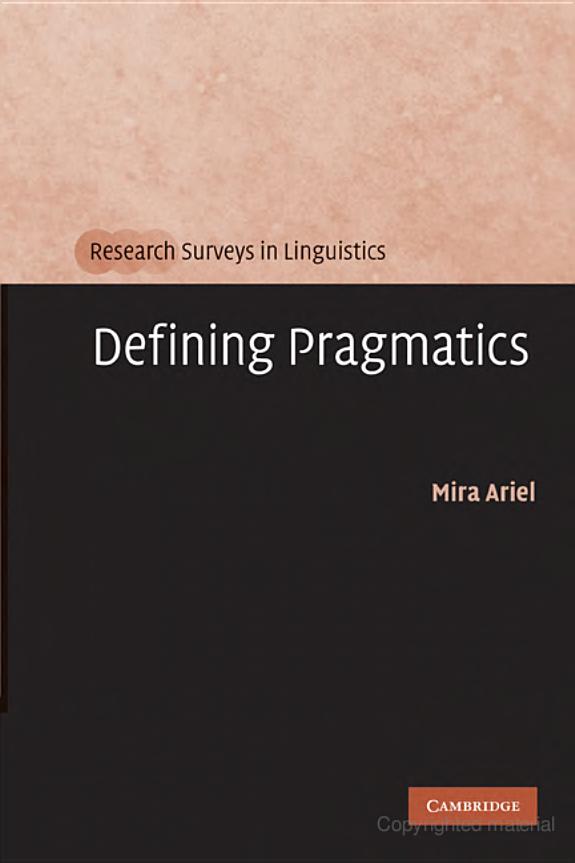
Defining Pragmatics
by Mira Ariel
330 pages· 2010· ISBN 9780521732031
About
Research surveys in Linguistics In large domains of theoretical and empirical linguistics, scholarly communication needs are directly comparable to those in analytical and natural sciences. Conspicuously lacking in the inventory publications for linguists, compared to those in the sciences, are concise, single-authored, non-textbook reviews of rapidly evolving areas of inquiry. Research Surveys in Linguistics is intended to fill this gap. It consists of well-indexed volumes that survey topics of significant theoretical interest on which there has been a proliferation of research in the last two decades. The goal is to provide an efficient overview and entry into the primary literature for linguists - both advanced students and researchers -who wish to move into, or stay literate in, the areas covered. Series authors are recognized authorities on the subject matter as well as clear, highly organized writers. Each book offers the reader relatively tight structuring in sections and subsections and a detailed index for ease of orientation. Although there is no shortage of definitions for pragmatics (context-dependence, nontruthconditionality, implicitness, etc.), the received wisdom is that "pragmatics" simply cannot be coherently defined. In this ground-breaking book, Mira Ariel challenges the prominent definitions of pragmatics, as well as the widely held assumption that specific topics - implicatures, deixis, speech acts, politeness - naturally and uniformly belong on the pragmatics turf. She reconstitutes the field, defining grammar as a set of conventional codes, and pragmatics as a set of inferences, rationally derived. The book applies this division of labor between codes and inferences to many classical pragmatic phenomena, and even to phenomena considered "beyond pragmatics." Surprisingly, although some of these turn out pragmatic, others actually turn out grammatical. Additional intriguing questions addressed in the book include: Why is it sometimes difficult to distinguish grammar from pragmatics? Why is there no grand design behind grammar or behind pragmatics? Are all extragrammatical phenomena pragmatic? Includes a basic introduction to the main topics in pragmatics Shows how different approaches to pragmatics can be integrated with each other Based on natural, attested examples, from many languages Extra examples are available online at www.cambridge.org/ariel "In a masterful confrontation with decades of received wisdom, Mira Ariel redefines the proper task of pragmatics in a simple, crystal-clear way. An essential read."-Arie Verhagen. Leiden University Centre for Linguistics "...a new way to unify the field of linguistic pragmatics. Ariel critically surveys ten criteria for defining pragmatics, and argues for equating it with inferential as opposed to encoded meaning. She then shows how to apply the definition to the complete range of topics taken to constitute pragmatics in a broad sense."-Nancy Hedberg, Simon Fraser University
Discuss Defining Pragmatics with other readers
Join or start a book club for Defining Pragmatics on Readfeed. Live chat, shared reading progress, and AI discussion questions — free to get started.
Frequently asked questions
How do I join a book club for Defining Pragmatics?
Sign up free on Readfeed, then browse public clubs or start your own club with Defining Pragmatics as the current read. Invite friends with a share link and discuss together with live chat and AI discussion questions.
Can I discuss Defining Pragmatics with other readers online?
Yes. Readfeed book clubs let you chat live, share progress, and join discussions about Defining Pragmatics with readers worldwide — whether your club is virtual, in-person, or hybrid.
Is Readfeed free?
Yes. Creating an account and joining book clubs is free. Sign up to find readers who love the same books and start discussing today.