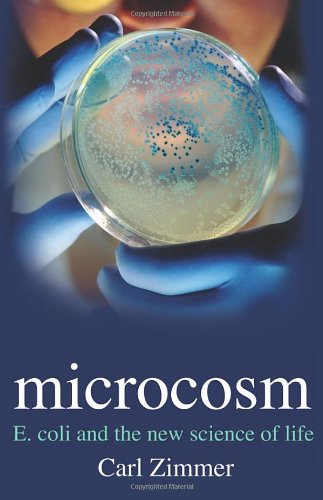
Microcosm

Microcosm

E-coli and The New Science of Life

by Carl Zimmer

256 pages· 2012· ISBN 9781446455036

Browse books you can read free on Readfeed

No club is reading this yet — be the first to start one

Start a club free
About
In 1946, a twenty-year-old medical school student called Joshua Lederberg decided to find out whether microbes make love. Lederberg was motivated not by a displaced libido, but by scientific ambition. At the age of seven, he had declared that he hoped to become 'like Einstein' and to 'discover a few things in science.' The 'few things' Lederberg discovered would revolutionise modern science and earn him a Nobel Prize. He chose to observe the breeding habits of a certain bacterium called Escherichia coli, better known as E coli. His experiments used defective E coli strains lacking the essential molecules to reproduce by cloning which should, by rights, perish in the petri dish. But slowly, a few colonies of survivors began to spread accross the dishes. The only possible explanation for their survival was that they were a product of sex. Not only had Lederberg proved that bacteria have sex, he had also proved they have genes. Since then, a bacterium that was once nothing more than a humble resident of the human gut has become our best guide to what it means to be alive. Most of us might only know E coli for its lethal strain that causes food poisoning, but Zimmer uses E coli as a prism to understand what life is, what it was, and what it will become. We learn how E coli microbes talk to each other, how studies of their evolution represent the most powerful evidence in support of natural selection, and how they might just explain life on other planets...

Discuss Microcosm with other readers

Join or start a book club for Microcosm on Readfeed. Live chat, shared reading progress, and AI discussion questions — free to get started.

Frequently asked questions

How do I join a book club for Microcosm?

Sign up free on Readfeed, then browse public clubs or start your own club with Microcosm as the current read. Invite friends with a share link and discuss together with live chat and AI discussion questions.

Can I discuss Microcosm with other readers online?

Yes. Readfeed book clubs let you chat live, share progress, and join discussions about Microcosm with readers worldwide — whether your club is virtual, in-person, or hybrid.

Is Readfeed free?

Yes. Creating an account and joining book clubs is free. Sign up to find readers who love the same books and start discussing today.